From a depot shelf in China to your letterbox: shipping lines explained
The four things that set the price of a shipping line, how a box size turns into a weight, which goods most lines refuse, and three parcels built from this catalogue.
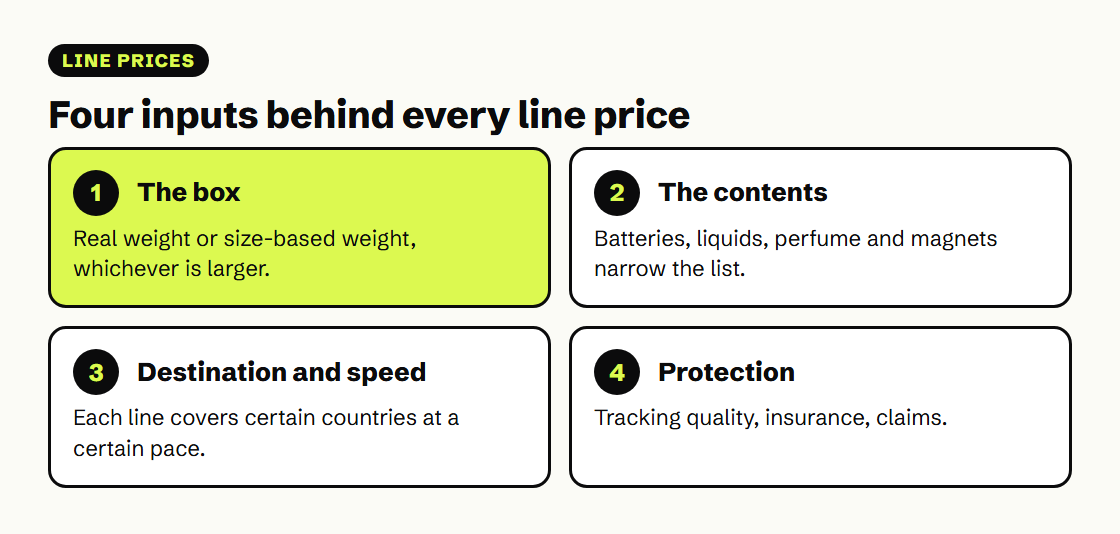
The four things that set a line's price
When an agent shows you a list of shipping lines for a packed parcel, every price on it comes from the same four inputs. Knowing them tells you which ones you can change.
- The box. Real weight and box size, of which the line charges on the larger.
- What is inside. Ordinary clothing travels on almost every line. Batteries, liquids, perfume, magnets and powders narrow the list sharply.
- Where it goes and how fast. Each line covers certain countries at a certain speed, and faster costs more.
- How well it is protected. Tracking quality, insurance and the claims process differ by line, and some extras cost money.
You choose the second, third and fourth when you pick the line. You control the first when you decide what goes in the parcel and how it is packed, which is why the next section spends the most time on it.
From box size to billed weight, with a worked box
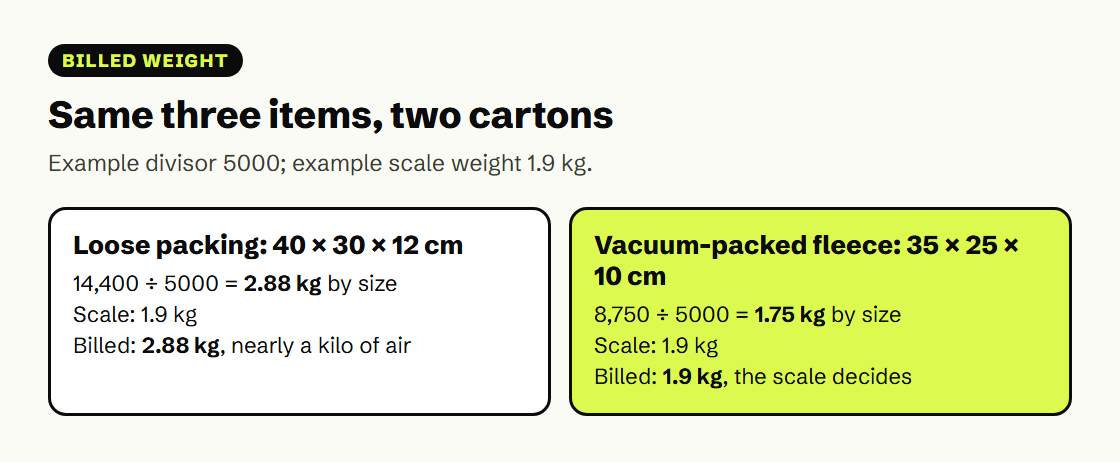
Shipping lines carry space as well as weight, so a light parcel in a big box is charged as if it were heavier. The line works out a size-based weight by multiplying the three edges of the box in centimetres and dividing by a number it publishes, then bills whichever is larger: that figure or the real weight on the scale. Agents call it volumetric weight, and each line sets its own divisor.
A worked example, using a divisor of 5000. A pair of jeans, a fleece jacket and a canvas tote go into a carton 40 by 30 by 12 centimetres. The size-based weight is 40 × 30 × 12 = 14,400, divided by 5000, which gives 2.88 kg. Suppose the scale reads 1.9 kg. The line bills 2.88 kg, almost a kilo of air.
Now ask the warehouse to vacuum-pack the fleece and fold the jeans into the tote, and the same goods fit a carton of 35 by 25 by 10. That box gives 8,750 ÷ 5000 = 1.75 kg, below the real weight, so the line bills the 1.9 kg on the scale. Nothing was left out; the parcel only stopped paying for empty space.
Our box weight check runs this sum for any box and divisor. Ask your agent which divisor each line uses; it is usually written in the line's details.
Goods most lines turn away, and the workarounds
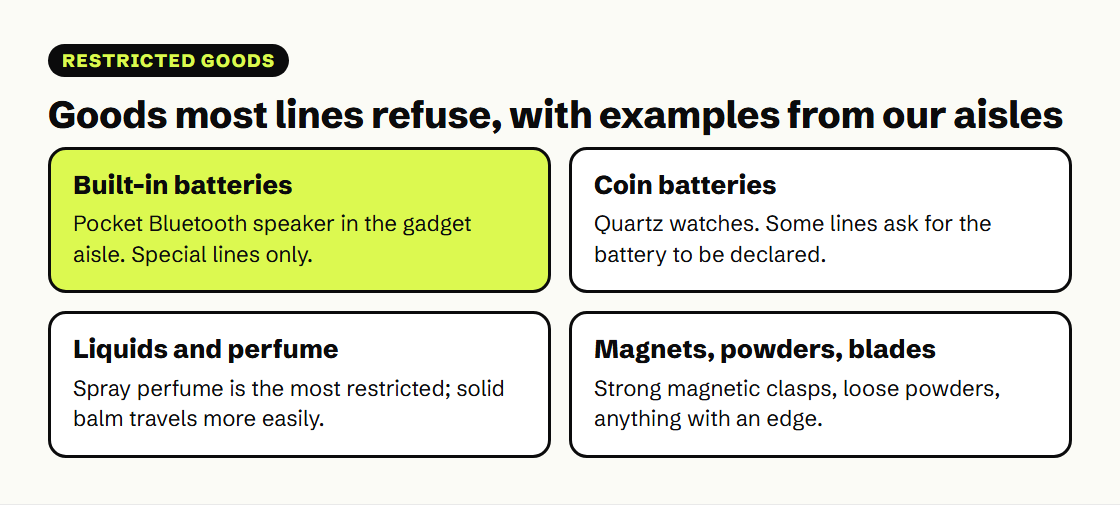
Airlines restrict what can fly in cargo, and shipping lines pass those rules on. Four groups cause most of the refusals at packing time, and three of them appear in our own aisles.
- Built-in batteries
- Bluetooth speakers, earbuds, power banks, anything that charges. Only some lines accept them, and power banks are refused by most. The speakers and gadgets in our scent and gadget aisle are marked.
- Coin batteries
- Quartz watches carry a small battery. Many lines treat a watch as ordinary goods, but some ask for the battery to be declared, and a few refuse it.
- Liquids and perfume
- Perfume is both a liquid and flammable, which puts it on the most restricted list. Solid perfume balms travel more easily than sprays, which is one reason our scent shelf leans towards them.
- Magnets, powders and blades
- Strong magnets interfere with aircraft instruments; powders look suspicious on a scanner; knives and tools with blades are restricted almost everywhere.
The practical rule is to ask before you buy, not after. Tell the agent what you plan to ship and to which country, and ask which lines will take it. If none will, the item is not a bargain at any price.
Line families, from slowest and cheapest to fastest
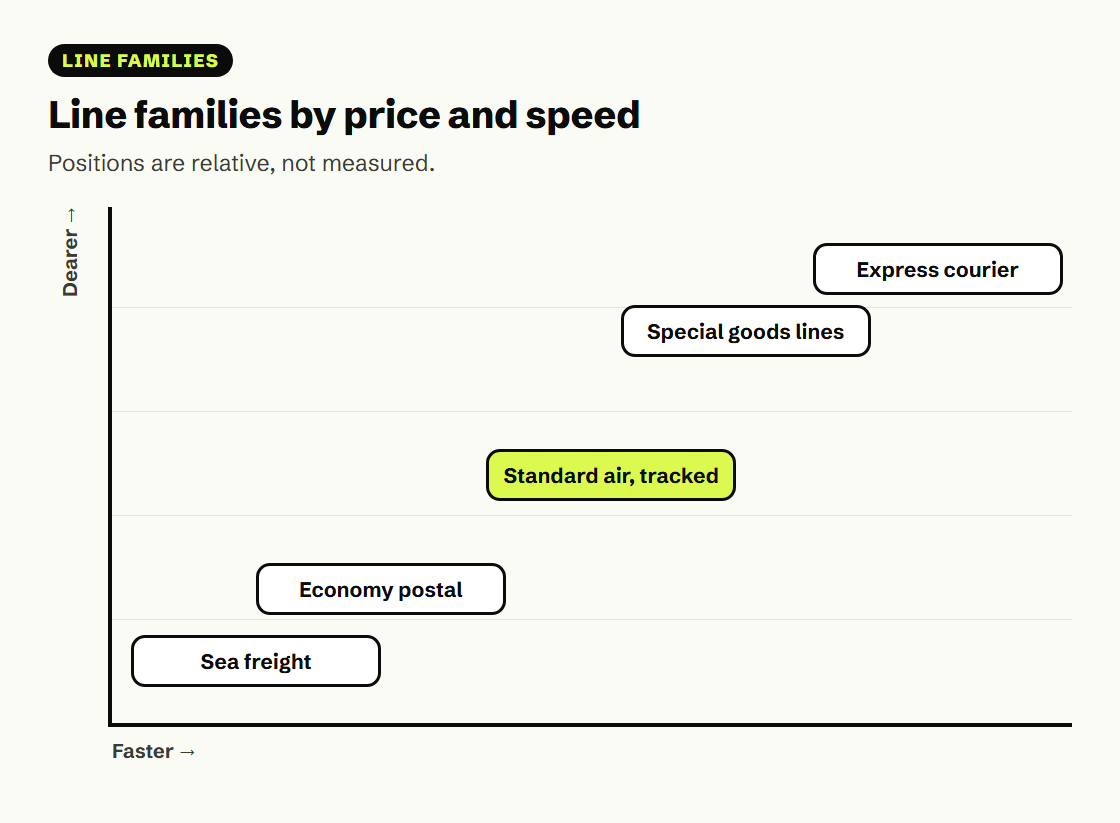
Line names differ by agent and change often, but most fall into one of five families. Knowing the family tells you what to expect even when the name means nothing.
Economy postal
Handed to the Chinese postal service and then to yours. Low price, long and uneven transit, patchy tracking in the middle. The SAL example in the Upopbuy app screenshot belongs here.
Standard air with tracking
The workhorse for clothing. Tracked end to end, delivered by your local post or a courier, transit measured in weeks rather than months.
Express courier
Fastest and dearest, often a week or so door to door. Import tax is usually collected by the courier, sometimes with a handling fee.
Special goods lines
Lines set up to carry batteries, liquids or cosmetics, at a premium. Fewer destinations, stricter packing.
A fifth family, sea freight, makes sense only for heavy parcels and patient buyers. For most clothing hauls the choice is between economy and standard air, and the difference is usually worth paying for when the parcel holds anything you would mind losing, because tracking is what a claim is built on.
Customs value, cover and claiming for a loss
Every international parcel carries a customs declaration listing its contents and value. The agent fills it in from what you tell it. Declare the price you paid for the goods. It is the figure your country's rules expect, it is what any insurance pays out on, and it is what the agent's receipts will show if customs ask.
Insurance is usually an optional percentage of the declared value, sometimes with a cap per parcel. It matters most on economy lines, where tracking is thin and a lost parcel is hard to prove. Read what it covers: loss is common, damage less so, and seizure by customs almost never.
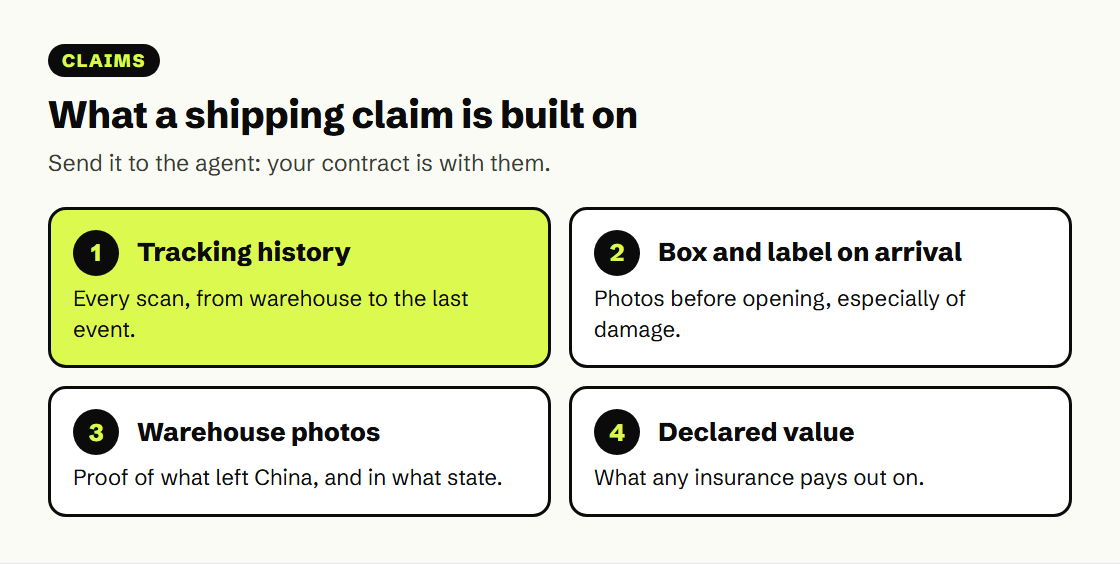
If something goes wrong, the claim goes to the agent, not the carrier, because the agent is your contract. A claim needs the tracking history, photos of the box and label on arrival, the warehouse photos from before shipping and the declared value. Most agents set a deadline for raising one, so check the rules before you need them.
Three parcels built from this catalogue
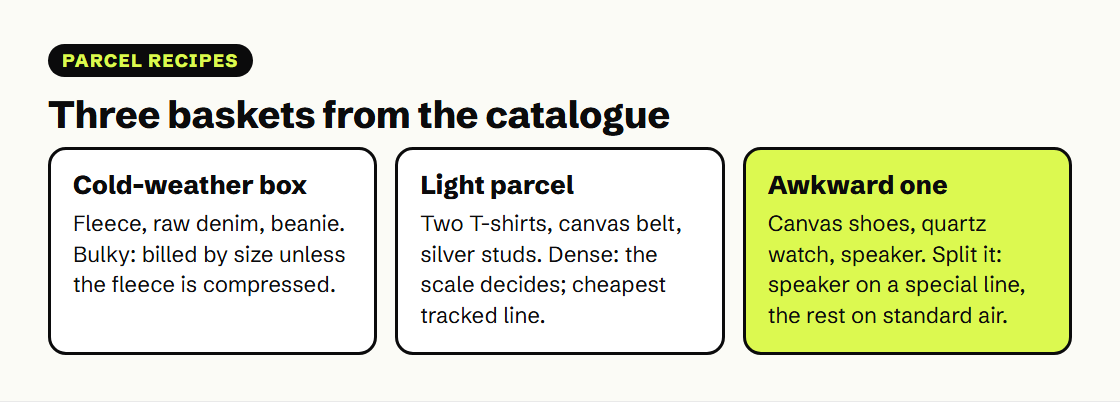
Here is how three typical baskets from our aisles behave when packed, to show how the rules above combine.
The cold-weather box
A fleece jacket, raw denim jeans and a knit beanie. All ordinary goods, so every line is open. The fleece is light but bulky, so this is the parcel where vacuum packing saves the most. Expect the size-based weight to decide the price unless the fleece is compressed.
The light parcel
Two heavyweight T-shirts, a canvas belt and a pair of silver studs. Small, dense and ordinary. The real weight will decide the price, so packing barely matters; the cheapest tracked line is usually the right one. Ask for the earring card to go inside a garment fold so it cannot slip out of the bag.
The awkward one
A pair of canvas shoes, a quartz watch and a pocket Bluetooth speaker. The shoe box doubles the size of the parcel, the watch may need its battery declared, and the speaker's battery removes most lines from the list. Splitting it in two, the speaker on a special goods line and the rest on standard air, is often cheaper than forcing all three onto the one line that accepts everything.
The aisle directory marks every item that needs one of these decisions.