
The Taobao order errand in ten handovers, any agent
How buying from Taobao through a shopping agent works with any agent that is open, told as ten handovers: what you give at each one, what comes back, and where it tends to go wrong.
Reading this guide: handovers, slips and one white T-shirt
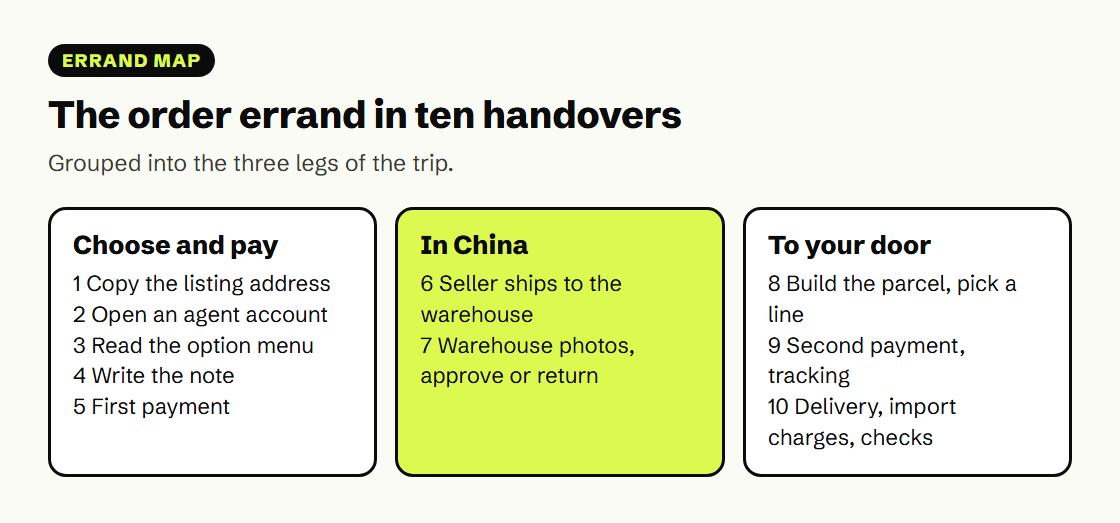
An agent purchase is a chain of small handovers. You pass the agent a link, it passes you a price; you pass it money, it passes the money to a seller; the seller passes a parcel to the warehouse, and so on until a box reaches your door. Each step below names both sides of the handover, then the mistake people make most often at that point.
The guide works with any agent. Upopbuy described itself as a Taobao agent, but as of 24 October 2026 its website does not load, so everything here is written for whichever service you use instead. Button names differ between agents; the steps do not.
To keep it concrete, we follow one real listing the whole way: a plain white heavyweight cotton T-shirt from a Taobao shop, item 670983038628, which we read on 24 October 2026. Its option menu has three quirks that trip people up, which is exactly why we chose it. The numbers in the dashed boxes are that listing's real prices; the agent charges and shipping rates in the example are invented round figures, labelled as such, because every agent sets its own.
Copy the listing address, not a share link
You hand over
Nothing yet. You are only collecting the product you want.
You get back
An item number that identifies the product, whatever the title says.
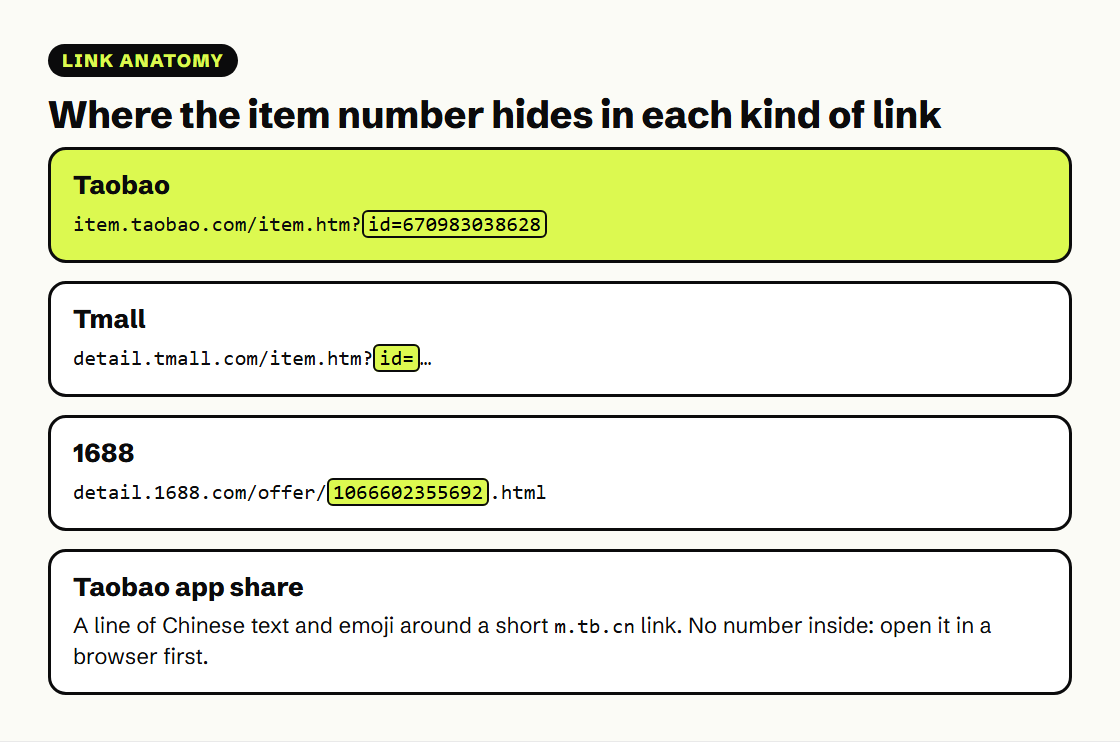
Every Taobao product has an item number. In a desktop browser it appears in the address after id=, as in item.taobao.com/item.htm?id=670983038628. Tmall uses the same pattern on detail.tmall.com, and 1688 puts the number after /offer/. Agents read these long addresses without trouble.
The Taobao phone app is less helpful. Its share button produces a short m.tb.cn link wrapped in a line of Chinese text and emoji, and many agents cannot open it. Open the share link in a browser first, let it redirect, and copy the full address it lands on. Our link tidy tool strips the tracking parts off a long address and tells you which marketplace it belongs to.
Where it slips: people paste the whole share message, emoji included, and the agent search returns a different product with a similar title. Check that the item number in the agent page matches the one in your link before you pay.
Our example order at this step: the clean address is item.taobao.com/item.htm?id=670983038628. The Chinese title, translated, describes a 340 g brushed white cotton T-shirt with a round neck.
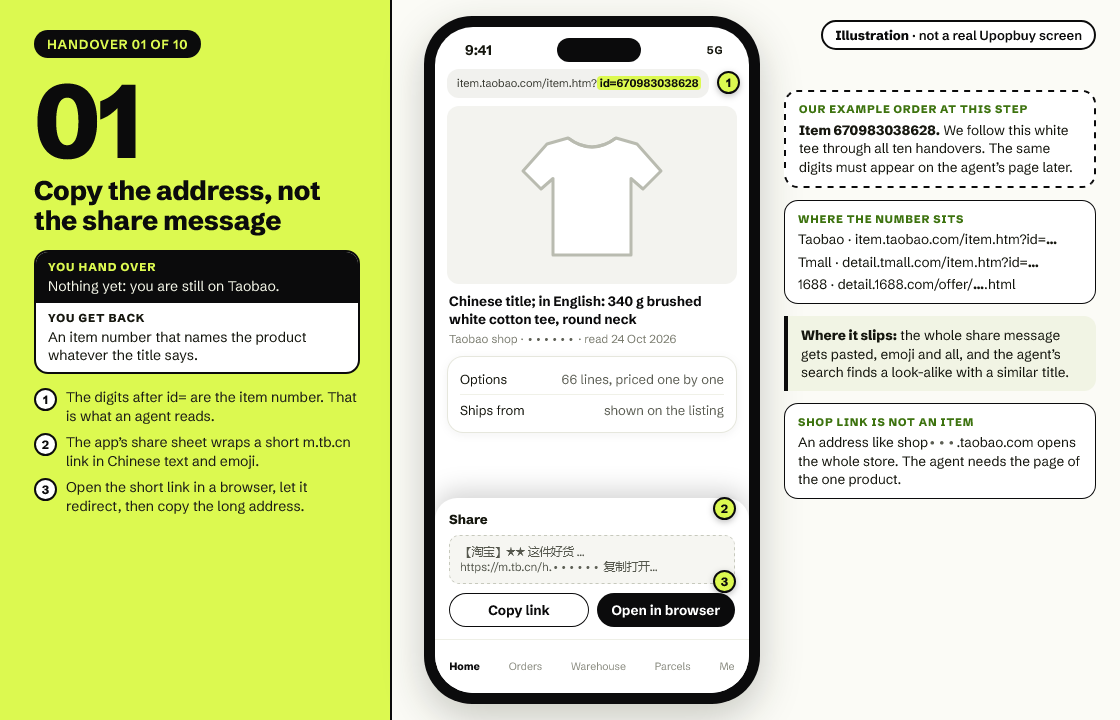
id=, which is what an agent reads. The share sheet wraps a short m.tb.cn link in Chinese text and emoji, and many agents cannot open that. Tap through the short link in a browser, let it redirect, then copy the long address. A shop address opens the whole store and will not work either.Sign up somewhere that answers its messages
You hand over
An email address, a password and, at some agents, a phone number.
You get back
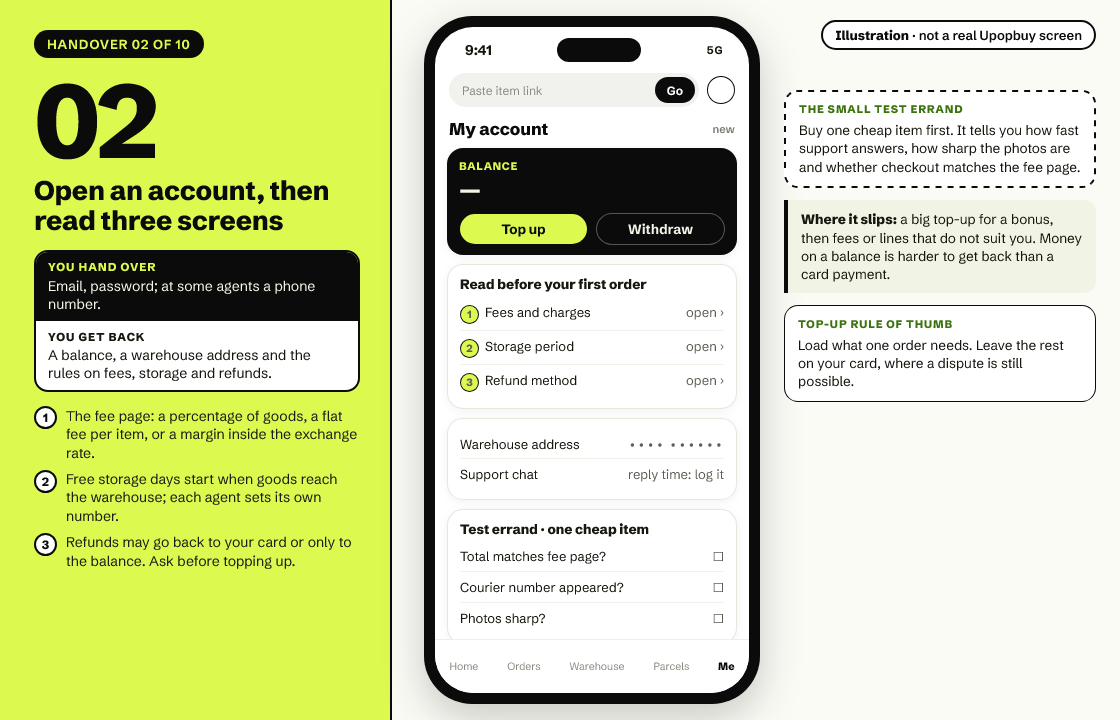
An account, a balance you can top up, and the agent’s rules on fees, storage and returns.
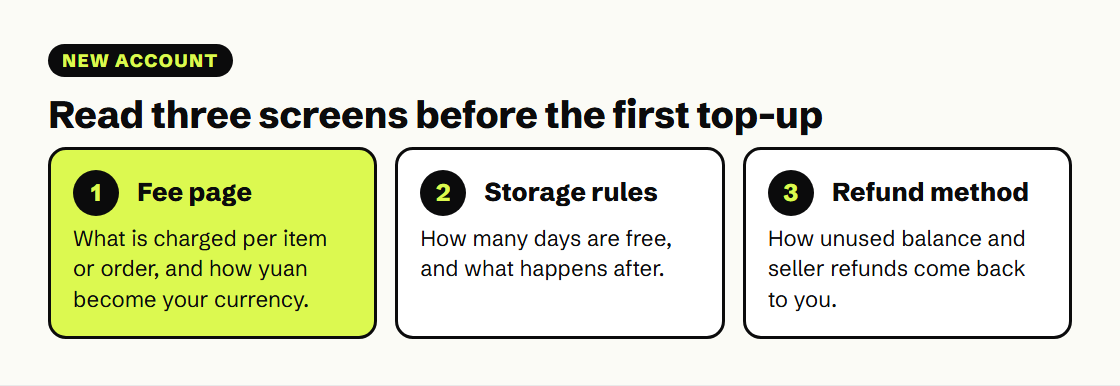
Registration itself is quick: an email, a password, sometimes a phone number. The useful part comes after, when you can see the agent's warehouse address, its storage rules and its fee page. Read those three before you put money in.
If you are choosing between agents, run the small test errand described on our agent page first. One cheap item will show you how fast support replies, whether the photos are sharp and whether the checkout total matches the fee page. Many agents ask you to top up a balance before buying; only top up what one order needs, so a card dispute stays possible if something goes wrong.
Where it slips: people top up a large balance to get a bonus, then discover the agent’s fees or lines do not suit them. A balance is harder to recover than a card payment.
Paste it in and read every option, slogans included
You hand over
The item link, pasted into the agent’s search or buy box.
You get back
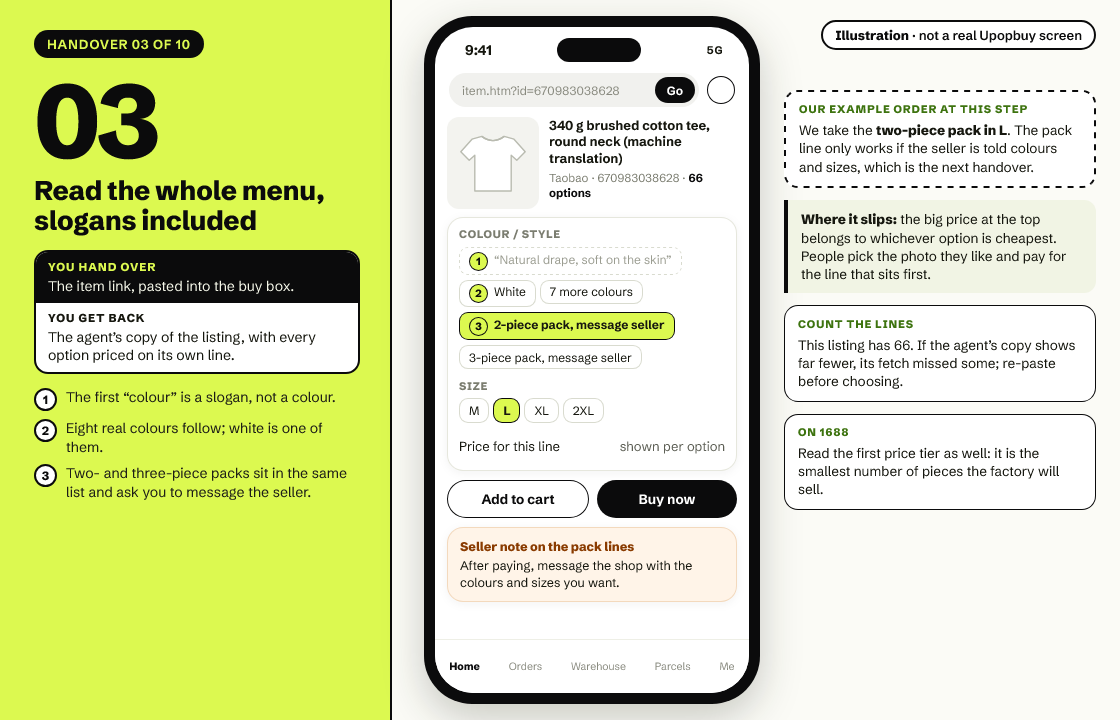
The agent’s copy of the listing: photos, a translated title and every option with its own price.
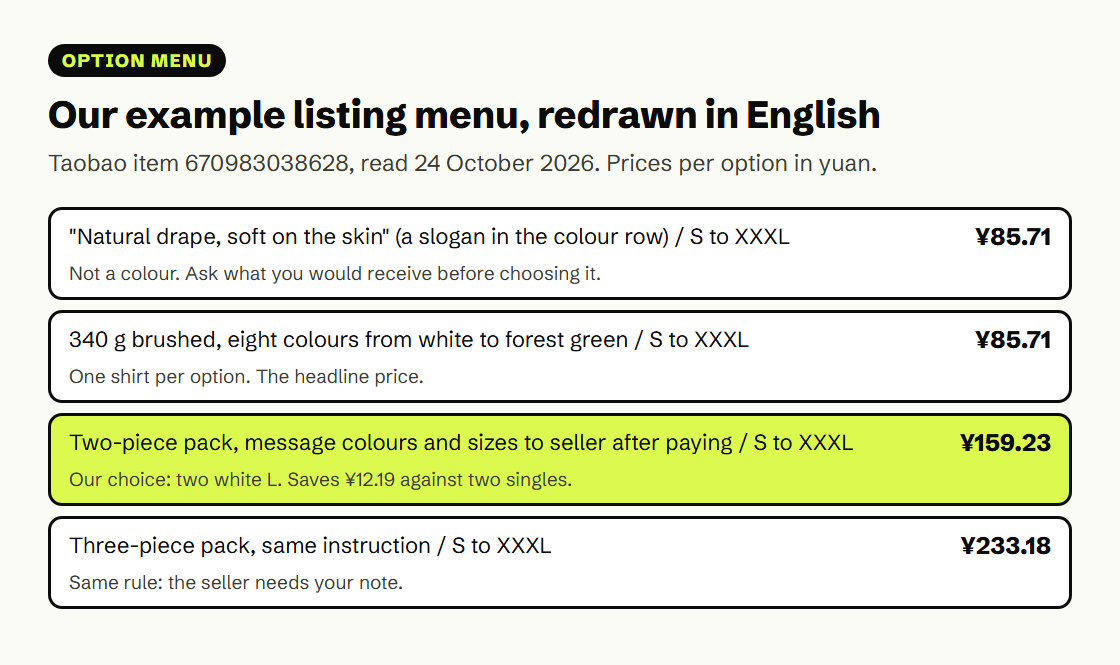
The agent page mirrors the Taobao listing, translated more or less well. The part that matters is the option menu, usually one list for colour or style and one for size. Each combination is a separate option with its own price and stock, and the price shown at the top of the page is simply the cheapest of them.
Read every option, not only the size list. Sellers use the colour list for anything they like: a slogan, a bundle, a different fabric, a gift. On 1688 there is one more thing to check: the first price tier, which shows the smallest number of pieces the factory will sell. A listing that looks like ¥15 a piece may only sell from three.
Where it slips: the headline price belongs to an option you do not want. Buyers pick the photo they liked, then pay for the option that happens to sit first in the menu.
Our example order at this step: the menu has 66 options. The first colour entry is not a colour at all but a slogan, which roughly translates as "natural drape, soft on the skin", at ¥85.71. Eight real colours of the 340 g brushed shirt follow, white among them, each at ¥85.71 for one piece. Then come a two-piece pack at ¥159.23 and a three-piece pack at ¥233.18, both labelled with an instruction to message the seller with colours and sizes after paying. We take the two-piece pack in size L, which saves ¥12.19 against two singles.
Write a remark a purchaser can follow
You hand over
A short note with the exact option, quantity and any condition.
You get back
An order that a person at the agent will buy exactly as written, or query with you first.
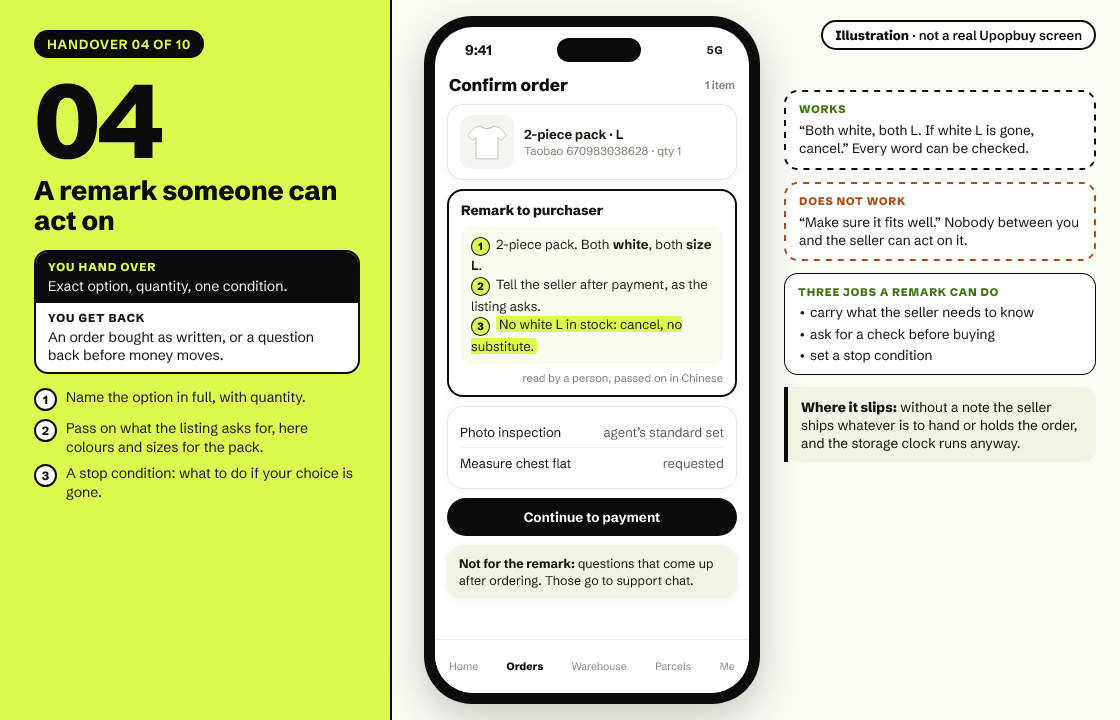
Almost every agent gives you a remark box on the order. A person at the agent reads it, and if needed passes it to the seller in Chinese. Keep it short, specific and checkable. "Two pieces, both white, both size L, please confirm with seller" works. "Make sure it fits well" does not, because nobody in the chain can act on it.
Use the note for three things only: instructions the seller needs (pack colours and sizes, as in our example), a request to check something before buying (the latest stock, a measurement, the real colour under daylight), and a stop condition ("if size L is out of stock, cancel, do not substitute"). Anything else belongs in a message to support after the order is placed.
Where it slips: the bundle options in our example only work if the seller is told the colours and sizes. Without a note, the seller ships whatever is to hand, or holds the order and waits, and the clock on your storage time starts anyway.
Our example order at this step: our note reads: "Two-piece pack. Both white, both size L. Please tell the seller after payment as the listing asks. If white L is not available, cancel."
First instalment: goods plus delivery inside China
You hand over
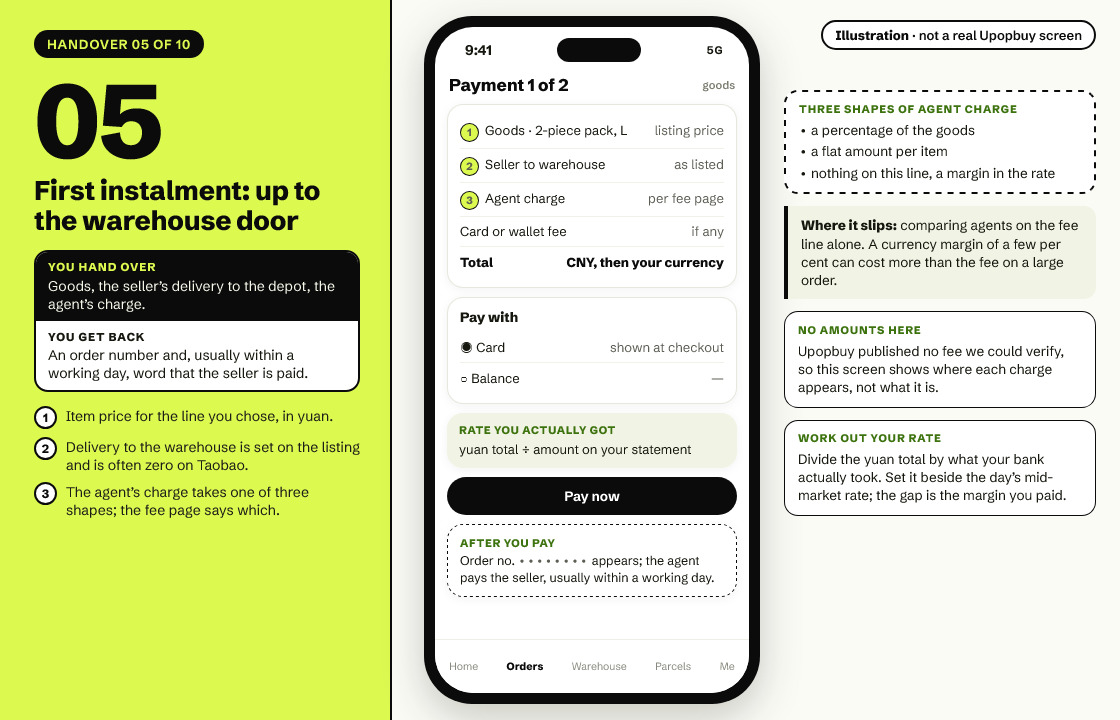
The first payment: item price, the seller’s domestic delivery fee and the agent’s charge on the purchase.
You get back
An order number and, usually within a working day, confirmation that the agent has paid the seller.
The first payment covers everything up to the warehouse door. The item price is in yuan; the shop's delivery charge to the depot is often zero on Taobao and shown on the listing; and the agent's own charge depends on the agent: a percentage of the goods, a flat fee per item, or nothing on this line and a margin built into the exchange rate instead. Card or wallet fees may be added at checkout.
The exchange rate matters more than people expect. Compare the yuan total with what you are charged in your own currency and work out the rate you actually got. Our costs page shows how, with a worked example.
Where it slips: people compare agents on the service fee alone and miss a currency margin of several per cent, which on a large order costs more than the fee.
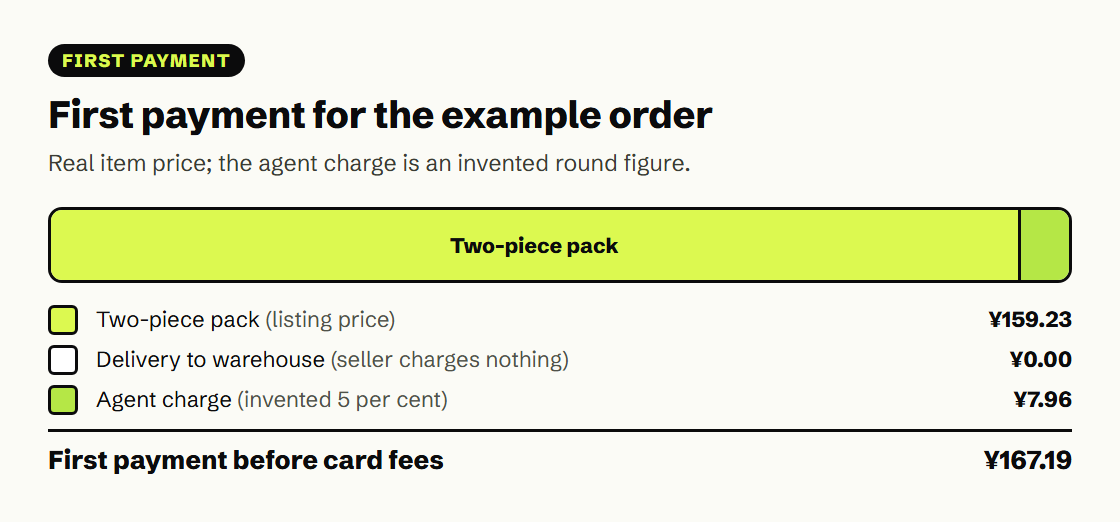
Our example order at this step: the pack costs ¥159.23 and the seller charges ¥0 delivery to the warehouse. With an invented 5 per cent agent charge of ¥7.96, the first payment is ¥167.19 before any card fee. Converted at the day’s rate, plus whatever margin the agent adds, that is the amount you see on your statement.
The quiet days while the shop dispatches
You hand over
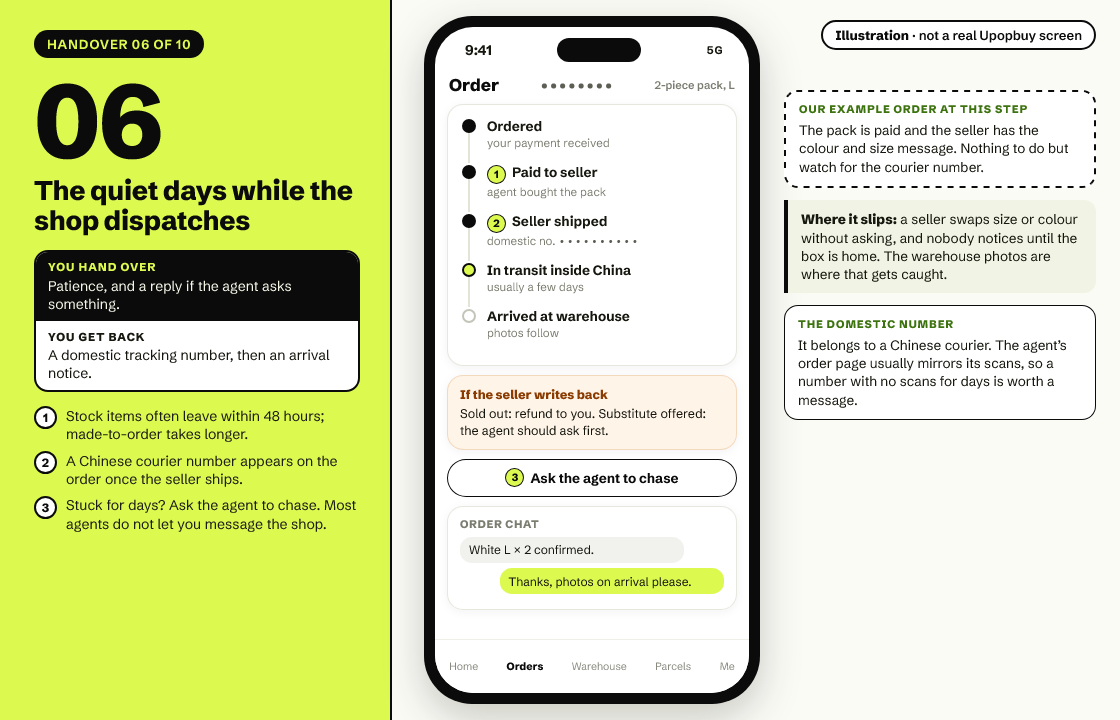
Nothing new, apart from patience and a reply if the agent asks you a question.
You get back
A domestic tracking number, then an arrival notice from the warehouse.
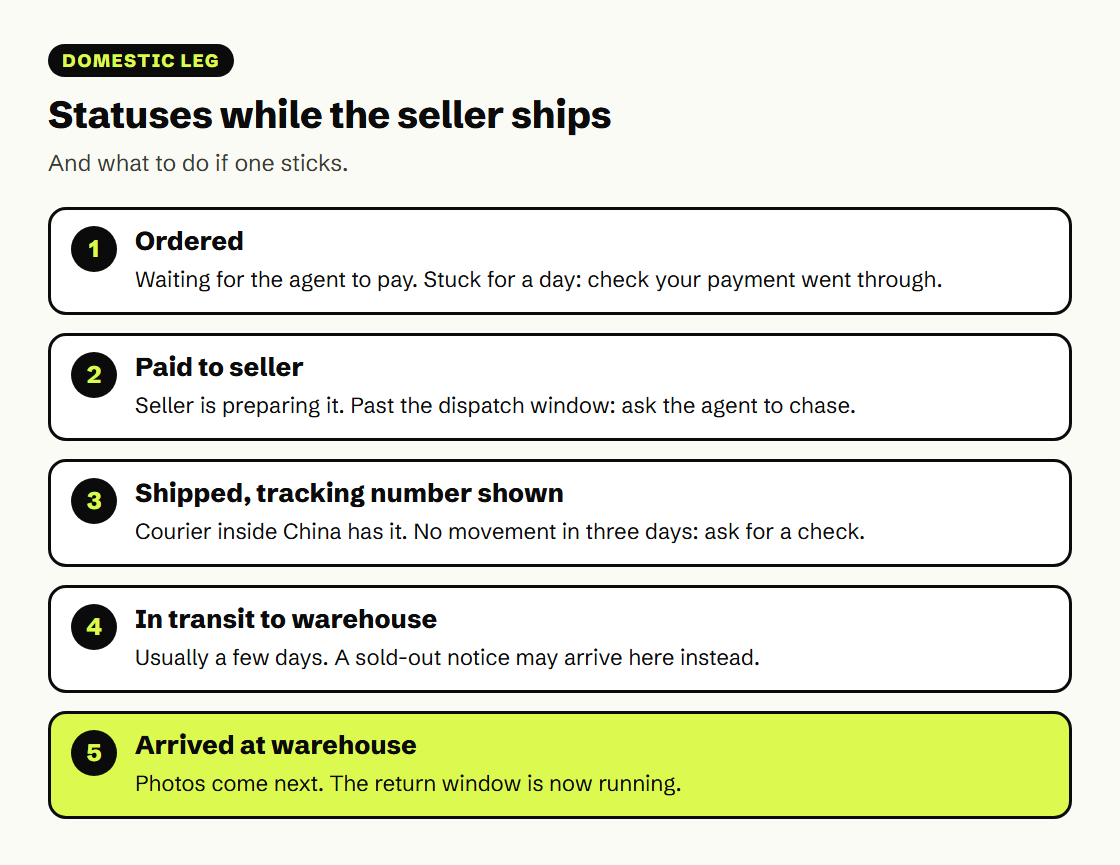
Once the agent has paid, the order sits with the seller. Taobao shops set their own dispatch time, often 48 hours for stock items and longer for anything made to order. When the seller ships, a Chinese courier tracking number appears on your order. From there, delivery inside China usually takes a few days, depending on how far the shop is from the warehouse.
Three things can happen on the way. The seller may report that an option is sold out and refund the agent, which refunds you. The seller may suggest a substitute, which the agent should ask you about. Or nothing happens at all for days, in which case ask the agent to chase the seller; you cannot contact a Taobao shop directly through most agents.
Where it slips: a seller swaps the colour or size without asking, and the buyer only notices weeks later. This is why the warehouse photos in the next step matter.
Depot photos: say yes, say no, or ask again
You hand over
Your approval, or a request to return or exchange, plus any extra photos or measurements you want.
You get back
Photos of the actual item, and a decision you can still reverse while it is in China.
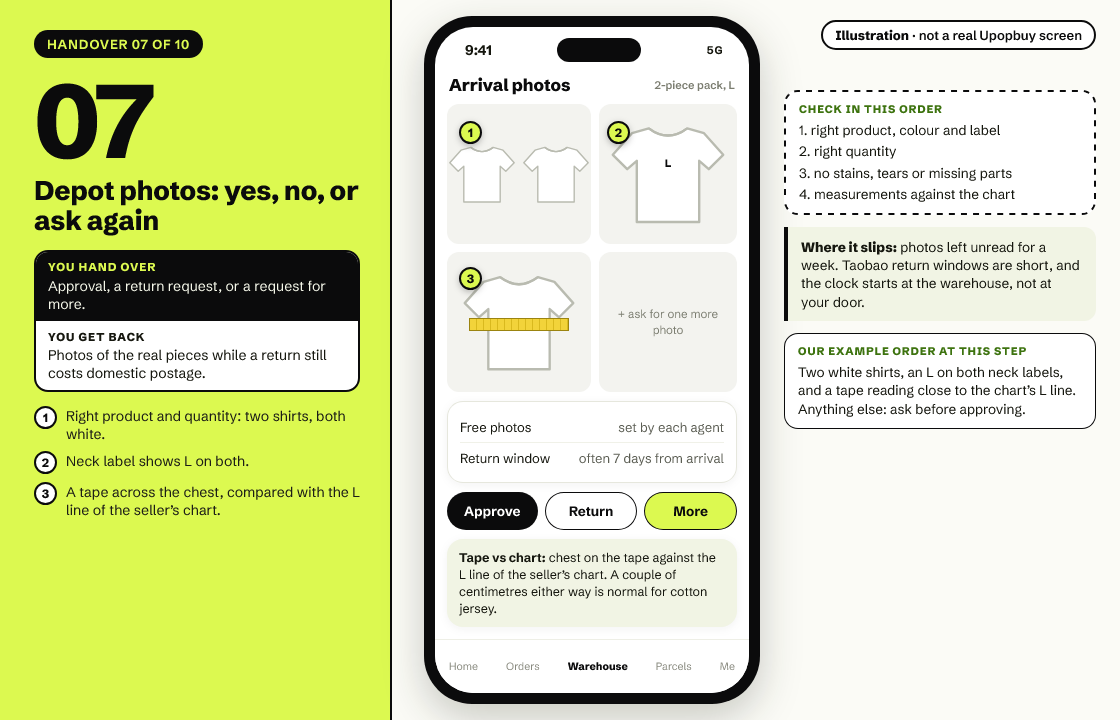
When the parcel reaches the warehouse, staff open it and photograph the item. These quality check photos are your only look at the goods while you can still send them back cheaply, because the seller is in the same country and the return costs domestic postage, not international.
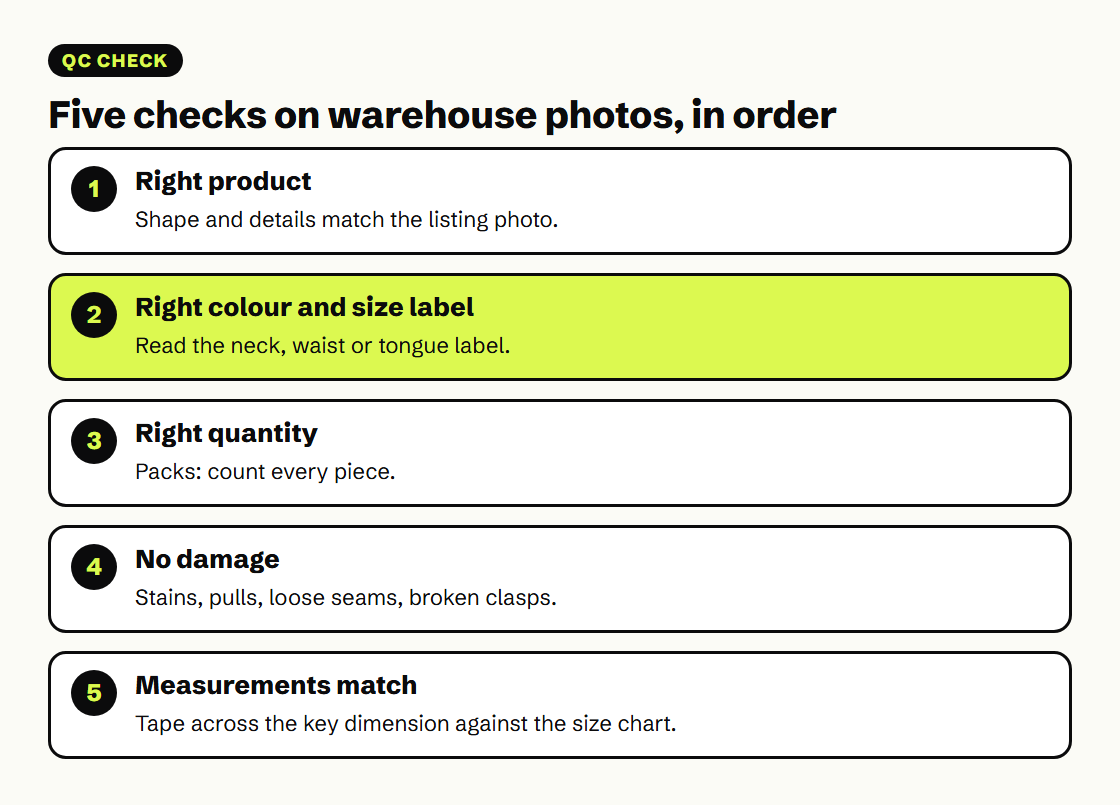
Check, in this order: that it is the right product, the right colour and the right size label; that the quantity is right, which matters with packs; that nothing is stained, torn or missing; and that the measurements, if you asked for them, match the seller's size chart. Our QC page has a checklist for each type of product in the catalogue.
Where it slips: returns to Taobao sellers have short windows, often seven days from delivery to the warehouse. Photos that sit unread for a week can mean the window has closed.
Our example order at this step: we would look for two shirts, both white, both with an L on the neck label, and a flat-lay photo with a tape across the chest. The seller’s size chart gives the chest width for L, so the tape should show a number close to it.
Packing the box and choosing its route abroad
You hand over
Which items to send, how to pack them, which line, and the value to declare.
You get back
A packed, weighed parcel and a firm shipping quote.
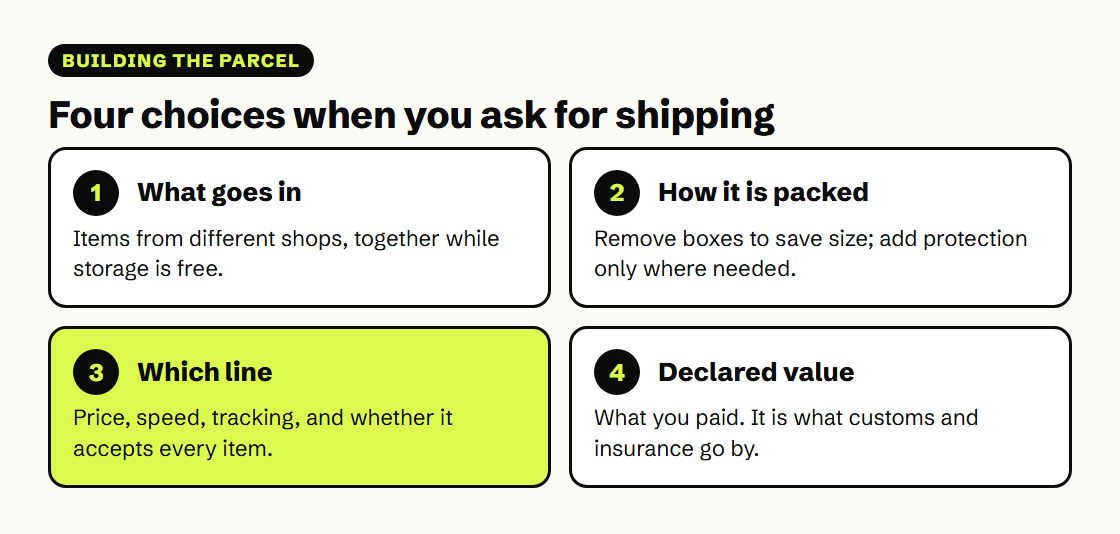
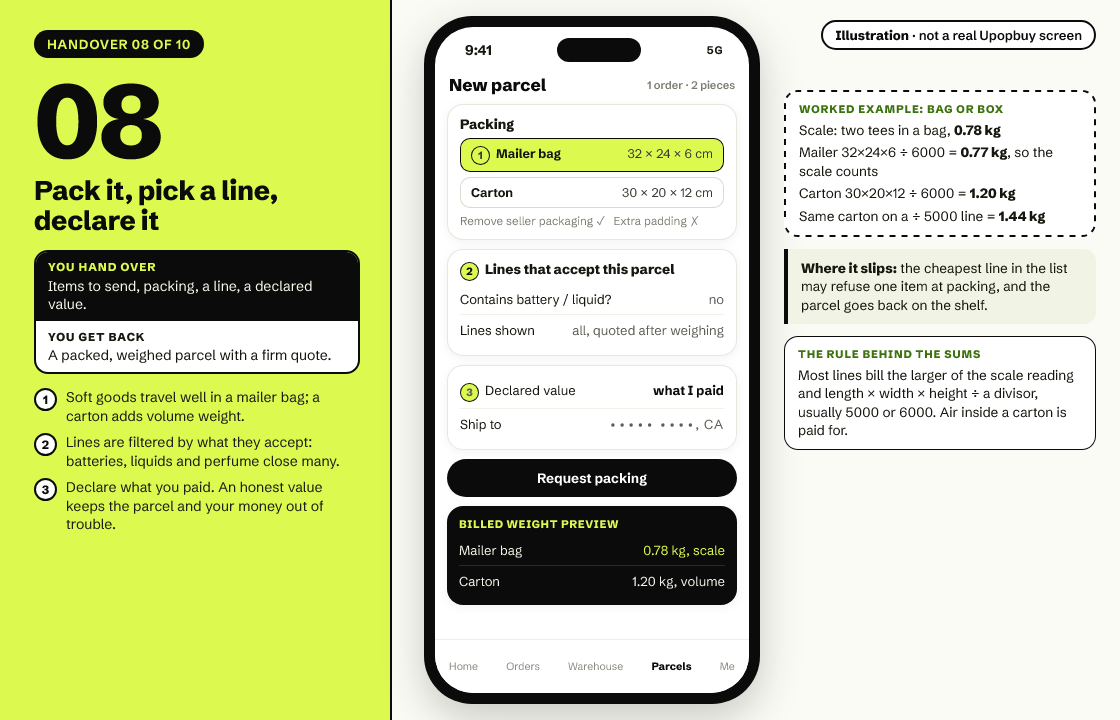
Items wait in the warehouse until you ask for them to be shipped. Most agents let you group items from different shops into one parcel, choose how they are packed, and then quote a list of shipping lines for that parcel. Packing choices change the price: removing shoe boxes and bulky packaging can shrink a parcel a lot, while extra padding or a rigid box adds weight.
The line list is where most of the money goes. Lines differ in price, speed, tracking quality and what they accept: many refuse batteries, liquids or perfume. Each line charges on whichever is larger, the real weight or one calculated from the size of the carton. The shipping page explains that rule with a worked box, and our box weight check does the sum.
You will also be asked for a declared value for customs. Declare what you paid. Agents cannot change the rules of your country, and an honest declaration is the one that keeps the parcel and your money out of trouble.
Where it slips: people pick the cheapest line in the list without checking what it accepts, and the parcel is refused at packing because one item has a battery.
Second instalment and the tracking number
You hand over
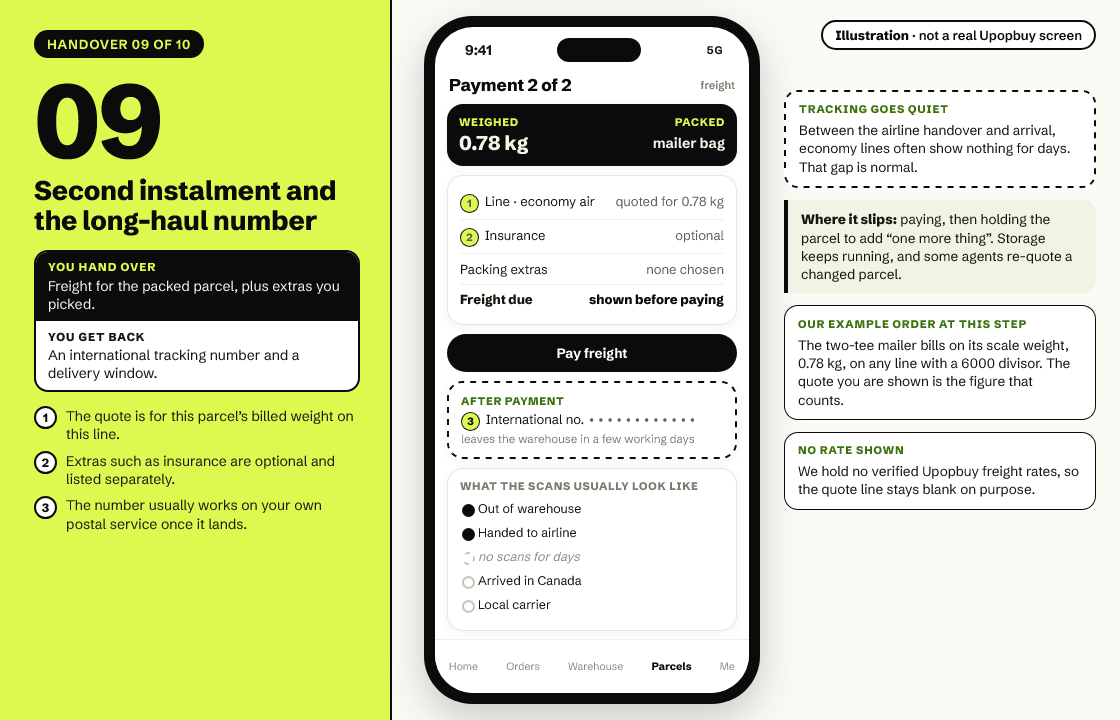
The second payment: freight for the packed parcel and any extras you picked.
You get back
An international tracking number and an estimated delivery window.
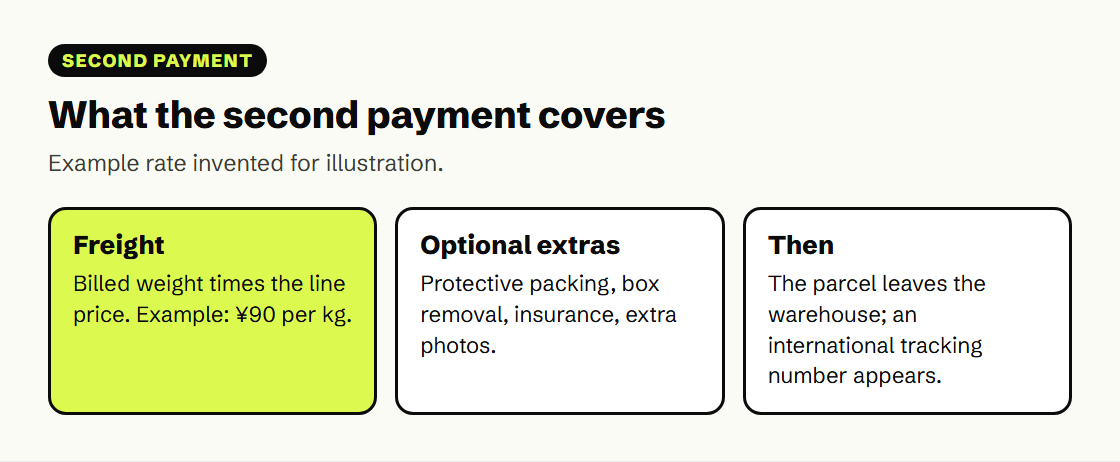
The second payment is the international shipping charge for the packed parcel, plus anything else you chose at packing: extra protection, insurance, removing boxes. Pay it and the parcel leaves the warehouse, usually within a few working days, and an international tracking number appears.
Tracking often goes quiet after the parcel is handed to an airline and before it reaches your country. That gap is normal on economy lines. Once it arrives, the tracking number usually works on your national postal service or the local courier as well, and their page tends to show more detail.
Where it slips: people pay for the freight and leave the parcel unsent for weeks while they add "one more thing". Storage time keeps running, and some agents re-quote the freight if you change the parcel.
Our example order at this step: the agent weighs the two shirts with packaging and quotes the freight for the box. Our invented rate of ¥90 per kilo is only for the diagram; your quote is the number that counts.
Doorstep, import charges and what is still fixable
You hand over
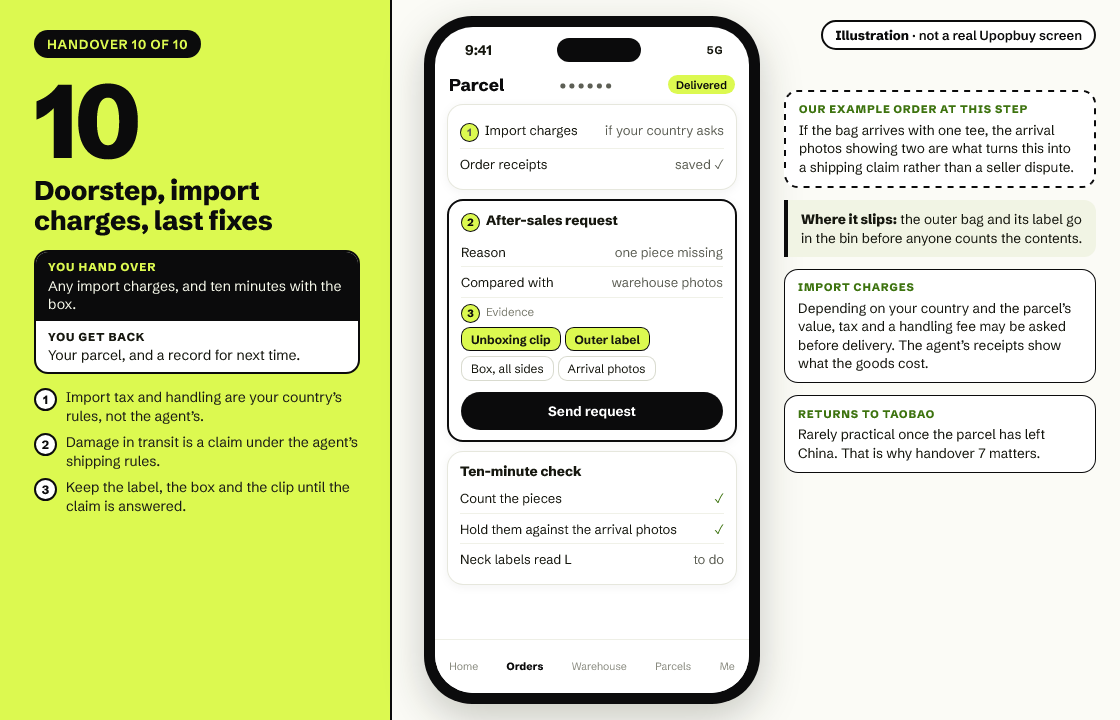
Any import charges your country sets, and a few minutes to check the box against the photos.
You get back
Your parcel, and a record of what worked for next time.
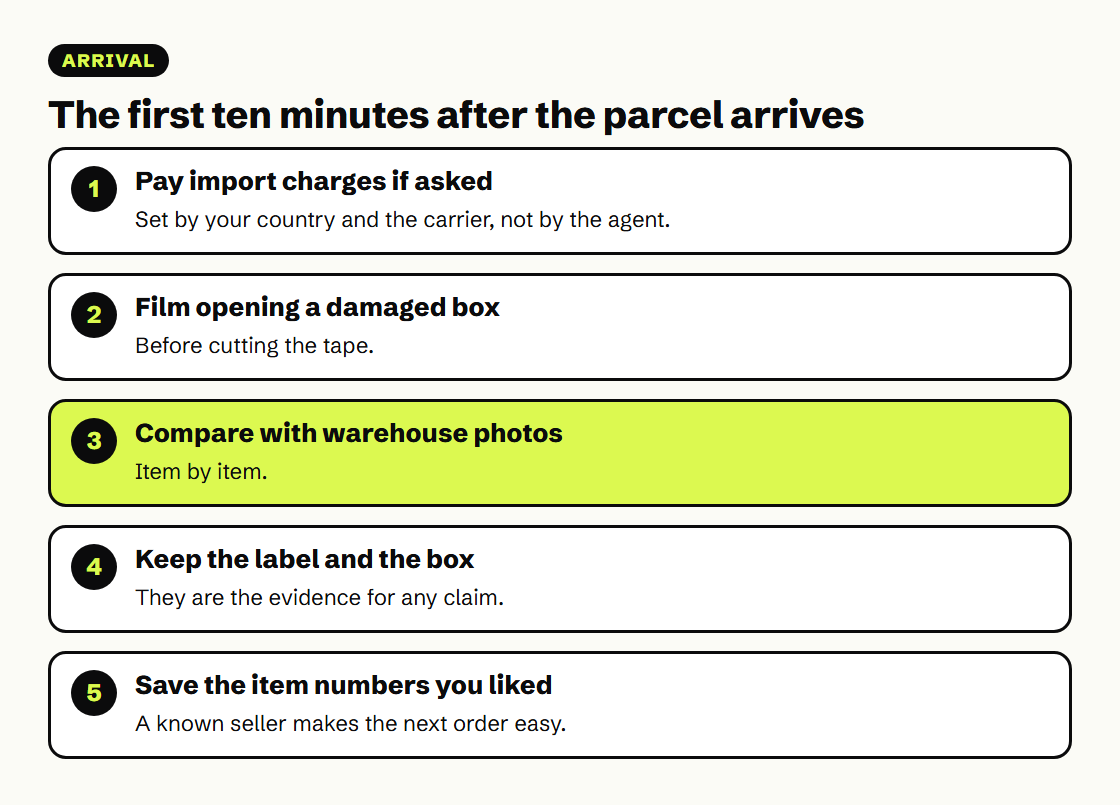
Depending on where you live and what the parcel is worth, you may be asked for import tax and a handling fee before delivery. Those charges belong to your country's rules and the carrier's paperwork, not to the agent. Keep the order receipts the agent sent you: they show what you paid for the goods if anyone asks.
When the box arrives, open it on camera if the parcel looks damaged, and check it against the warehouse photos. Items damaged in transit are a claim with the agent under its shipping rules; a wrong item that the photos show was right when it left is a much harder case. Returns to Taobao after the parcel has left China are rarely practical, which is why step seven matters so much.
After a successful errand, keep the item numbers of anything you liked. The same shop often sells the next colour or size, and a known seller is the easiest order you will ever place.
Where it slips: people throw away the outer box and the label before checking the contents. If something is missing, the label and the box are the evidence a claim needs.
The whole errand on one card
The ten handovers above in two lines each, for when you only need a reminder:
- Copy the full listing address and check the item number.
- Open an account with an agent you have tested; top up only what one order needs.
- Read every option in the menu, including the colour list and, on 1688, the batch size.
- Write a note that a person can act on, with a stop condition.
- Pay the goods and domestic delivery; work out the exchange rate you got.
- Watch for the domestic tracking number; ask the agent to chase a slow seller.
- Check the warehouse photos within days, not weeks.
- Pack lean, pick a line that accepts every item, declare what you paid.
- Pay the freight and keep the international tracking number.
- Pay any import charges, check the box against the photos, keep the label.
Ready to choose something? The aisle directory has sixteen shelves to start from, and each card notes the menu quirks we found.