Taobao shops, option lists and their small traps
Three decisions come before any agent order: which shop to trust, which listing and option to buy, and what to check before paying. Each one is answered here with real listings we read on 24 October 2026.
Three questions that sort a shop
You cannot visit a Taobao or 1688 shop in person, and through an agent you often cannot message it either. What you can do is read the signals the marketplace shows next to every listing. Three questions sort most shops quickly, and they are the fastest way of vetting sellers you have never used.
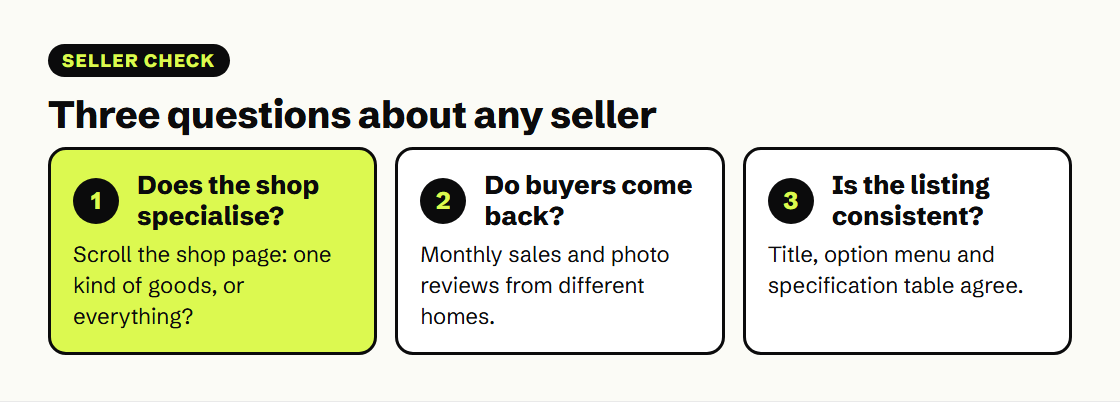
Does the shop make or stock this kind of thing?
A shop whose other listings are all heavy cotton basics is a better bet for a heavy cotton T-shirt than a shop selling phone cases, garden hoses and one T-shirt. Open the shop page from the listing and scroll. Specialist shops usually know their own sizes and fabrics, which means fewer surprises in the warehouse photos.
Do buyers keep coming back?
Monthly sales and the number of reviews say more than star ratings, which are almost always high. A listing with hundreds of sales and photo reviews from different buyers, taken in different rooms, is evidence that the thing exists and arrives. On 1688, the figure to read is the number of orders in the last month; the canvas crossbody bag on our one-size aisle showed 574 orders in the month before our visit.
Is the information consistent?
Compare the title, the option menu and the specification table on the listing. Good sellers keep them in line. A title promising leather over a specification table that says polyester, or a size chart that does not match the size menu, tells you the listing was assembled in a hurry. That is not proof of a bad seller, but it is a reason to ask for measurements in the warehouse photos.
Most wrong orders are the wrong option
Picking the right item comes down to reading the menu. Most disappointments with agent orders are not bad products. They are the wrong option of a good product. The option menu on Chinese listings is used for far more than colour and size, and it pays to read it as carefully as the photos.
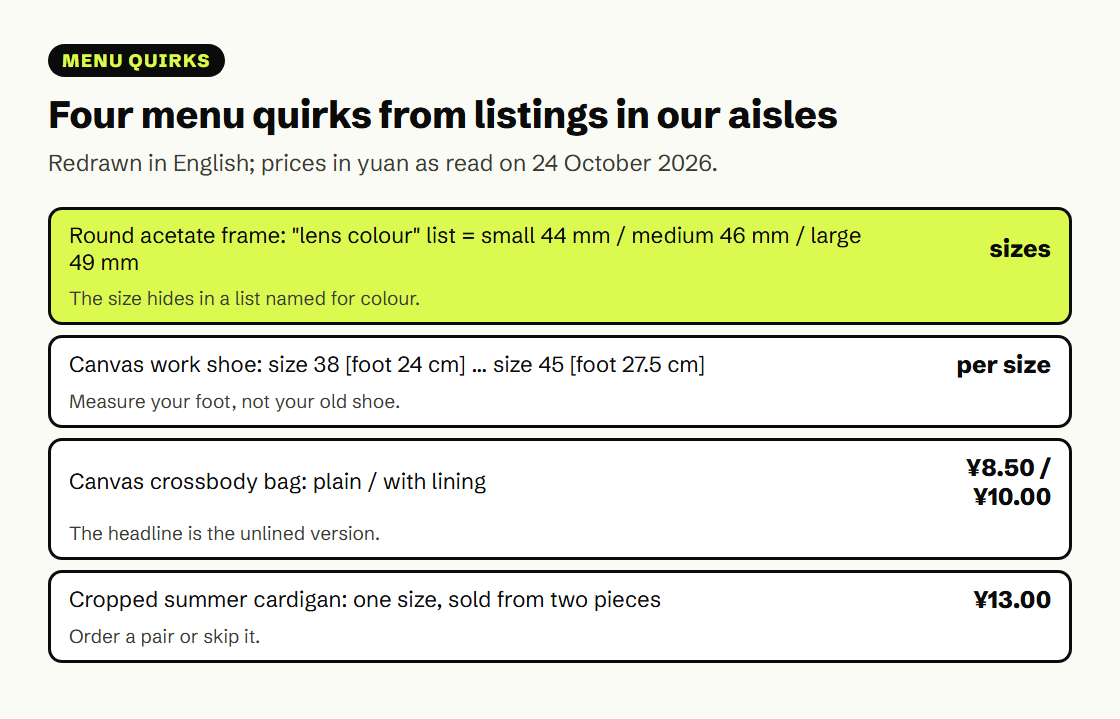
Here is what we found in the menus of listings on our own shelves:
- a round acetate frame on 1688 puts its three sizes in the list labelled "lens colour": small 44 mm, medium 46 mm and large 49 mm, which are lens widths. Pick by the colour list alone and you get whichever width sits first.
- a canvas work shoe on 1688 lists each size with a foot length beside it, size 38 for a 24 cm foot up to 45 for 27.5 cm. That is more useful than any conversion chart: measure your foot, not your old shoe.
- A canvas crossbody bag offers every colour twice, once plain at ¥8.50 and once "with lining" at ¥10.00. The headline price is the unlined one.
- A cropped summer cardigan comes in one size only, in a thin cooling fabric, and the factory sells from two pieces. Fine for a pair of colours; a surprise if you wanted one.
Before you choose, write down three things: the exact option, the size measurement you checked it against, and the price of that option, not the headline. If any one is uncertain, put it in the note to the agent.
Five traps we found on our own shelves
These are the mistakes we see most often in orders that went wrong, roughly in the order they happen.
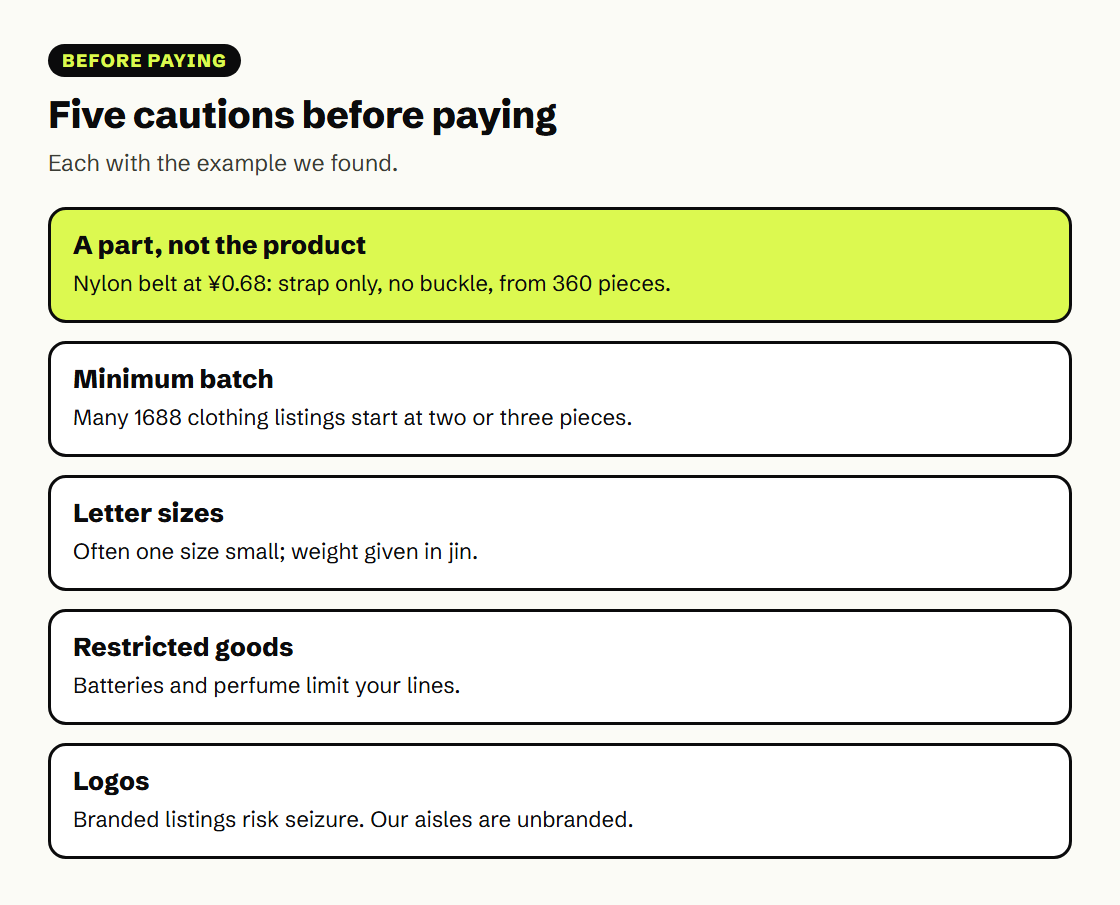
- Buying a part instead of the product
- a nylon belt listed at ¥0.68 on 1688 is a strap only: the option names say no buckle is included, and the first price tier starts at 360 pieces. Very low prices on 1688 often belong to a component, a sample swatch or a wholesale carton.
- Missing the minimum quantity
- Factories on 1688 set a minimum batch. Two or three pieces is common for clothing; some listings start in the hundreds. The first price tier on the listing shows it, and agents will not buy below it.
- Trusting the letter size
- Chinese letter sizes often run one size smaller than Western ones, and many shops size by body weight in jin (a jin equals 500 g). Use the measurement chart, and the flat-lay method to compare.
- Ignoring shipping restrictions
- A cheap speaker or a bottle of perfume is not cheap if only one expensive line will carry it. Check before buying; the shipping page lists the restricted groups.
- Chasing logos
- Listings that hint at famous brands in their titles or hide logos in the photos can be seized at customs, and agents may refuse to ship them. Every item in our aisles is unbranded for that reason.
None of these needs special knowledge, only the habit of reading the whole listing before pressing buy. The order errand builds that habit into its third and fourth steps.