What an agent order costs, instalment by instalment
Every charge between a Taobao price tag and a parcel at your door, in the order you meet them, with one worked bill and a way to find the exchange rate you were actually given.
Two payments to the agent, and sometimes a third at your door
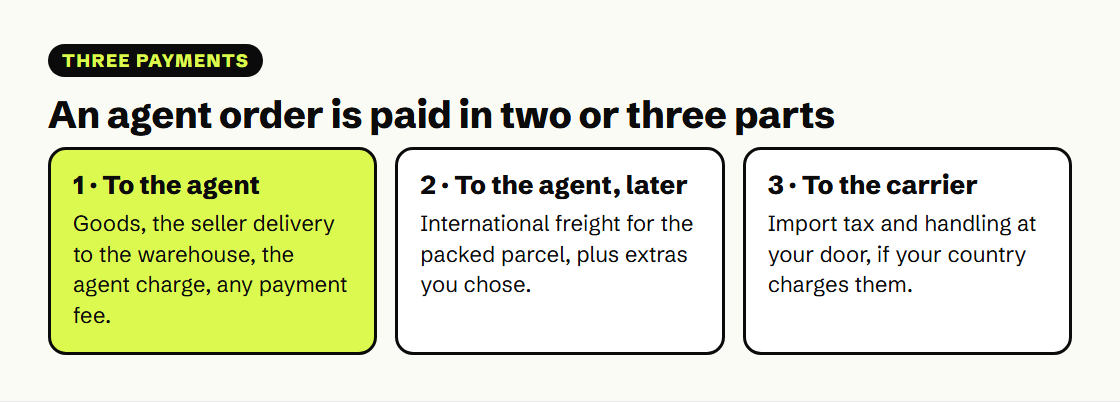
An agent order is never paid in one go. The first payment pays for the goods and for getting them to the depot in China. The second, often weeks later, covers the parcel's trip abroad. A third may be asked for at your door by the carrier, for import tax and handling, and that one has nothing to do with the agent at all.
Splitting the bill this way makes sense for the agent, which cannot know the parcel weight until everything has arrived, but it makes the true price of an item hard to see when you choose it. A ¥40 shirt is never a ¥40 shirt by the time it reaches you. The sections below go through each payment line by line, then add them up for a real two-item order.
First payment: goods, delivery inside China and the agent's charge
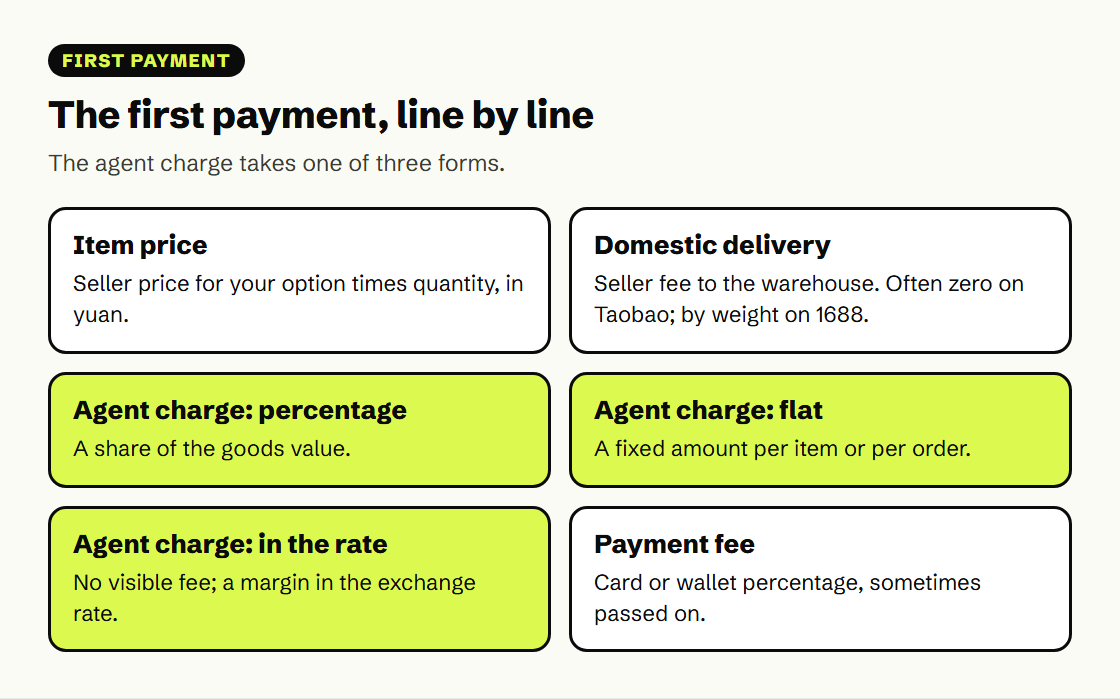
Four lines make up the first payment, though not every agent shows all four separately.
- The item price
- The seller's price in yuan for the option you picked, times the quantity. On 1688 the price per piece can fall as the quantity rises, in tiers shown on the listing.
- Domestic delivery
- The shop's fee for getting your item to the agent's depot. Taobao shops often charge nothing within mainland China; 1688 factories usually charge by weight or by carton. It is set by the seller, not the agent.
- The agent's charge on the purchase
- Agents earn on this step in one of three ways: a percentage of the goods value, a flat amount per item or order, or no visible fee with a margin built into the exchange rate instead. Some combine two. None of these is wrong; what matters is that you can see it before paying.
- Payment fees
- Cards and payment wallets can add a percentage at checkout, and some agents pass that on to you. A bank transfer or a top-up in a different way can be cheaper on large orders.
The first payment is where people compare agents, usually on the service fee alone. That is half the picture, because the exchange rate is applied to the whole first payment, and the next section shows how to find out what rate you really got.
Exchange rate: finding the rate you were really given
Agents price in yuan and charge you in your own currency, or ask you to top up a balance in dollars or euros. The rate they use is rarely the one you see on a currency news site. The gap is a legitimate way to earn money, but it should be a number you know, not one you discover on your statement.
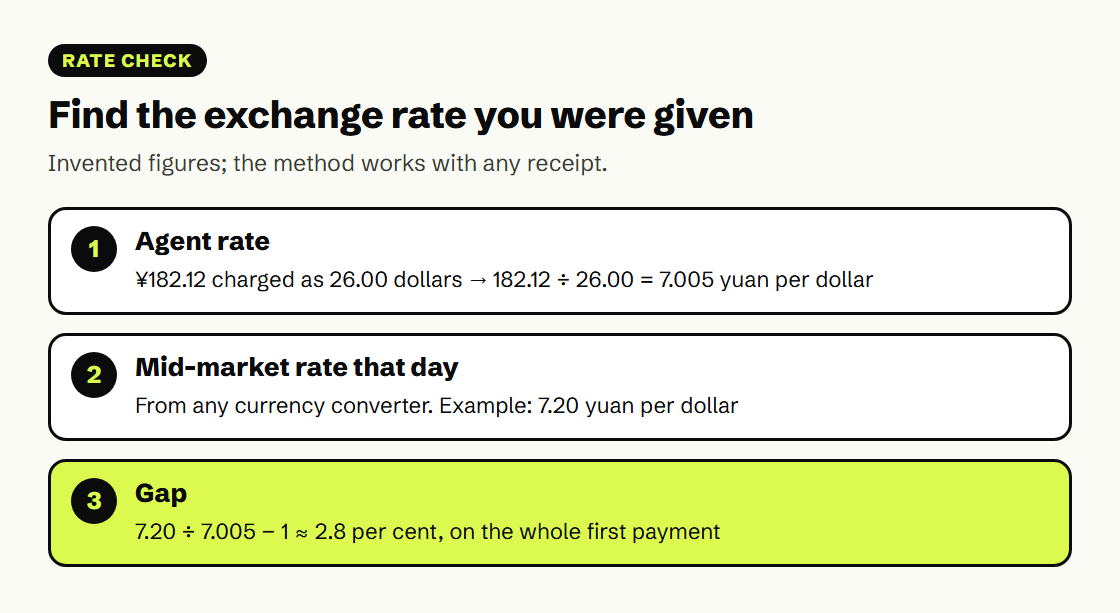
You can measure it with any receipt. Take the yuan total of an order and divide it by the amount actually charged in your currency. That gives the agent's rate in yuan per unit of your money. Then look up the mid-market rate for the same day on any currency converter, and compare the two:
- Agent rate = yuan total ÷ amount charged.
- Gap = mid-market rate ÷ agent rate − 1, written as a percentage.
Suppose, with invented numbers, an order of ¥182.12 is charged as 26.00 dollars. The agent rate is 182.12 ÷ 26.00 = 7.005 yuan per dollar. If the mid-market rate that day were 7.20, the gap would be 7.20 ÷ 7.005 − 1, about 2.8 per cent. On a ¥2,000 haul that gap is roughly the same money as a 3 per cent service fee, which is why we look at both together.
Two practical notes. Your card provider can charge a second conversion fee if the agent bills in a currency other than your card's, so pay in the same currency as your account where you can. And a prepaid balance freezes the rate on the day you top up, which can work for you or against you.
Second payment: freight plus the optional add-ons
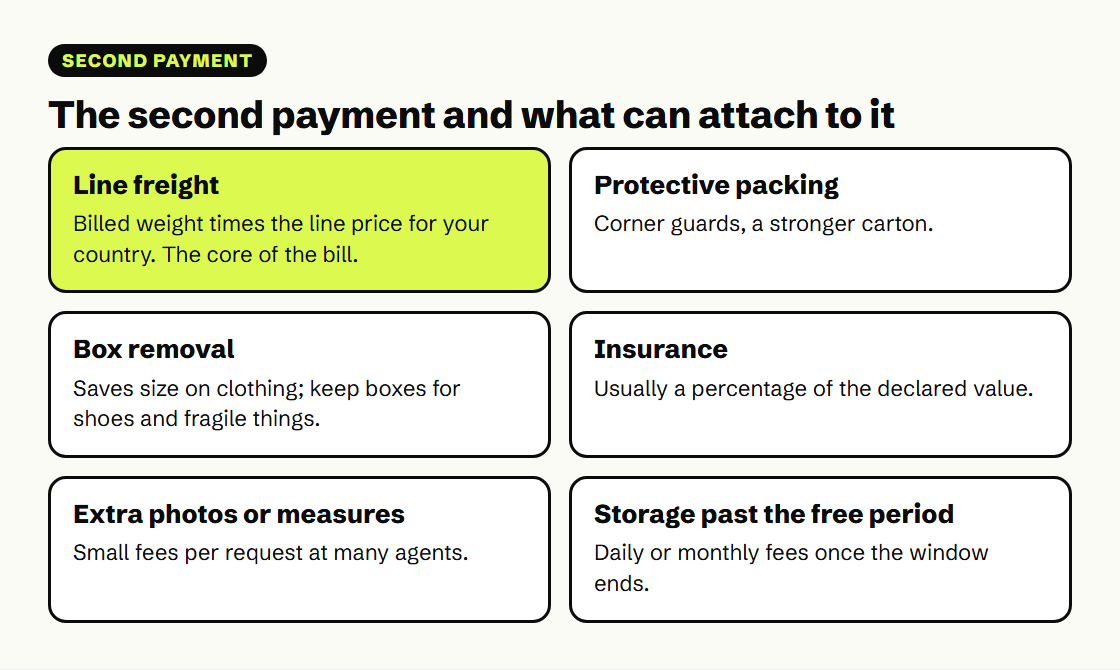
The second payment is calculated once your items are packed together and weighed. Its core is the shipping line's price for the parcel, which depends on the destination, the weight or the size-based weight, whichever is larger, and the kind of goods inside. The shipping page explains how lines are priced.
Around that core sit optional extras, priced differently by every agent: protective packing such as corner guards or a stronger box, removing original boxes to save weight, shipping insurance, extra photos or measurements requested at the warehouse, and storage fees if items stay past the free period. Each one is small on its own. Five of them together can add a noticeable share to the freight.
Two habits keep the second payment down. Ship more items together, because most lines charge a higher rate for the first half kilo than for each one after it. And ask for bulky packaging to be removed from anything that does not need it; a shoe box can double the size-based weight of a parcel that would otherwise fit in a bag.
The doorstep charge: import tax and handling
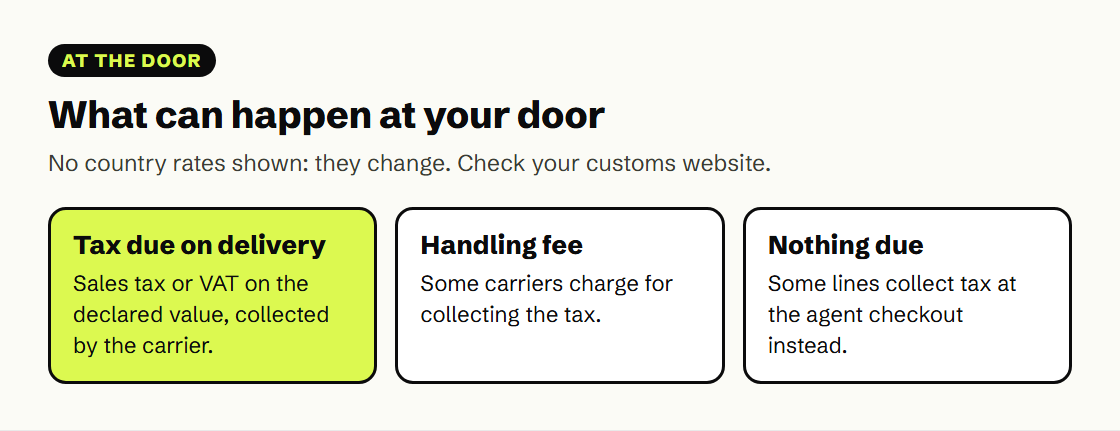
Whether you pay anything on delivery depends on your country, the declared value of the parcel, what is inside and how it is shipped. Many countries charge sales tax or VAT on imported goods even at low values, and some carriers add a handling fee for collecting it. Some lines collect tax at the agent's checkout instead, so nothing is due at the door.
We do not list thresholds or rates here, because they change and they differ for every country. Your government's customs or tax website states the current rules, and it is the only source worth trusting. What you can control is the paperwork: the declared value should match what you paid, and the agent's receipts should be kept until the parcel is delivered and any charge is settled.
When you compare the cost of buying through an agent with buying the same thing locally, include this charge. Leaving it out is the most common reason an order that looked cheap turns out not to be.
A whole bill, worked through for a two-item parcel
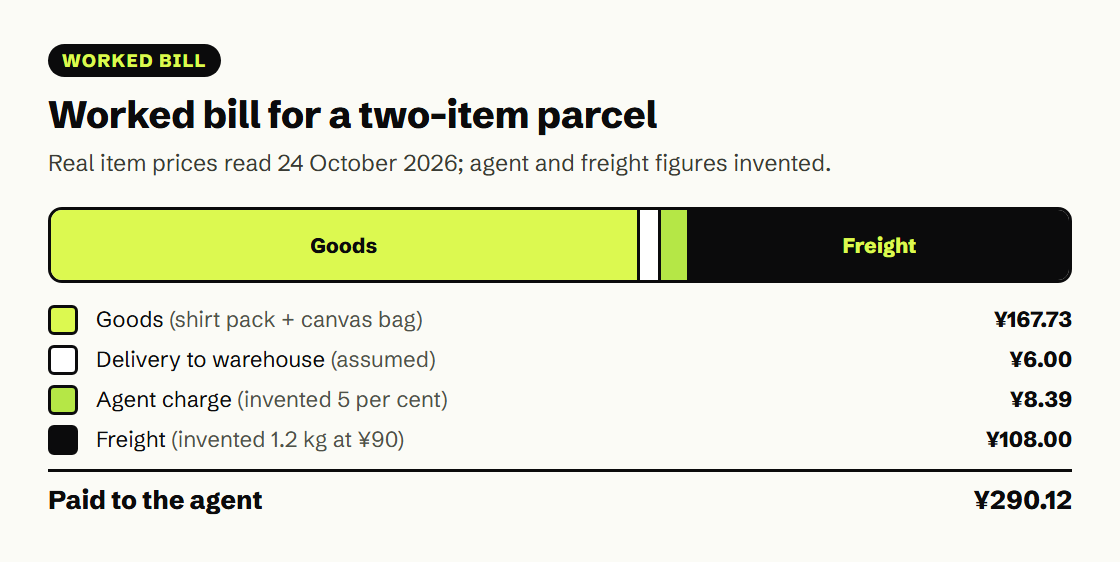
Here is the complete bill for a small parcel built from two real listings we read on 24 October 2026: the two-piece white T-shirt pack from our order errand at ¥159.23, and a plain canvas crossbody bag from a 1688 seller in our adjustable and one-size aisle at ¥8.50 for a single piece. The item prices are real. Everything the agent and the shipping line charge is an invented round figure, labelled, because those numbers belong to whichever agent you use.
| Line | Yuan | Where the figure comes from |
|---|---|---|
| T-shirt pack, two pieces | 159.23 | Listing price, read 24 October 2026 |
| Canvas crossbody bag | 8.50 | Listing price, read 24 October 2026 |
| Delivery to warehouse | 6.00 | Shirt shop charges 0; the bag seller's figure is assumed for the example |
| Agent charge, 5 per cent of goods | 8.39 | Invented rate for the example |
| First payment | 182.12 | Sum of the four lines |
| Freight, 1.2 kg at ¥90 per kg | 108.00 | Invented weight and rate |
| Total paid to the agent | 290.12 | Before card fees and any import charge |
The two items cost ¥167.73 on their listings. The parcel costs ¥290.12 before any card fee or import charge, so goods are under 58 per cent of the bill. That share rises as parcels get heavier and fuller, because freight grows more slowly than the goods value when you add items. Try your own numbers in the two-payment estimate.
Trimming the bill without cutting corners
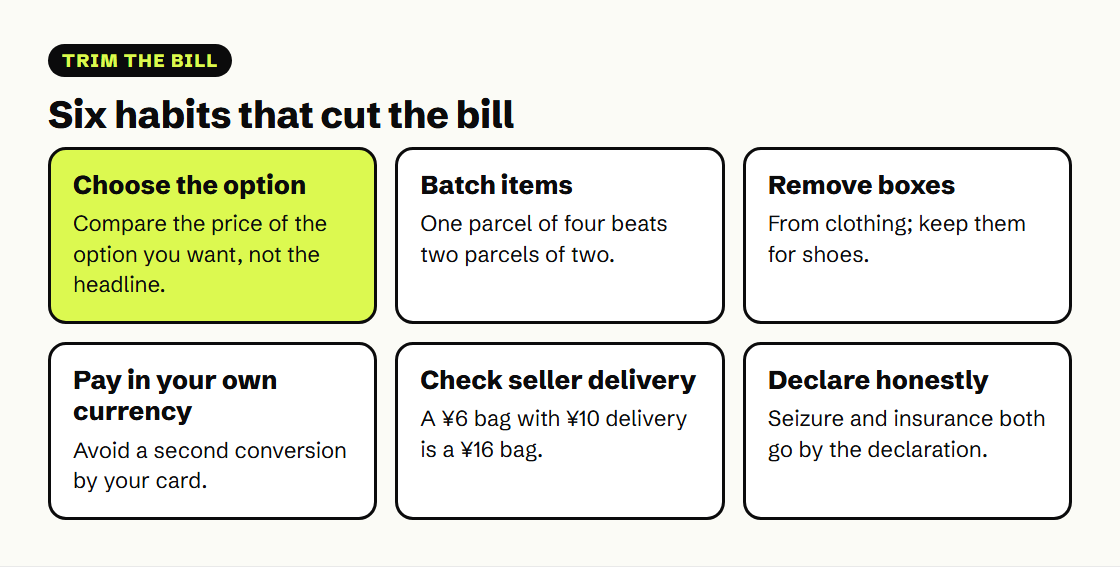
- Choose the option, not the photo. The cheapest price on a listing often belongs to a different option. Check what you are paying for before you compare.
- Batch your buying. One parcel of four items costs much less to ship than two parcels of two, as long as everything arrives within the free storage period.
- Ask for boxes to be removed from clothes, and keep them only for shoes or anything fragile.
- Pay in your account's own currency to avoid a second conversion by your card issuer.
- Check the seller's delivery fee on 1688 listings before adding a cheap item; a ¥6 bag with ¥10 domestic delivery is a ¥16 bag.
- Keep the declaration honest. Under-declaring to dodge tax can cost the whole parcel if it is checked, and insurance claims are paid on the declared value.
Before any of this, it is worth knowing which agent you are paying. The agent page covers how to read a fee page and what a fair one looks like.