About the Errand Book: who keeps it and how it earns
Why this catalogue exists, how each product gets onto a shelf, what we will not do, and how to tell us when we are wrong.
An independent book, not an Upopbuy page
As of 24 October 2026, upopbuy.com could not be reached: the secure address gave no response and the plain address returned a server error.
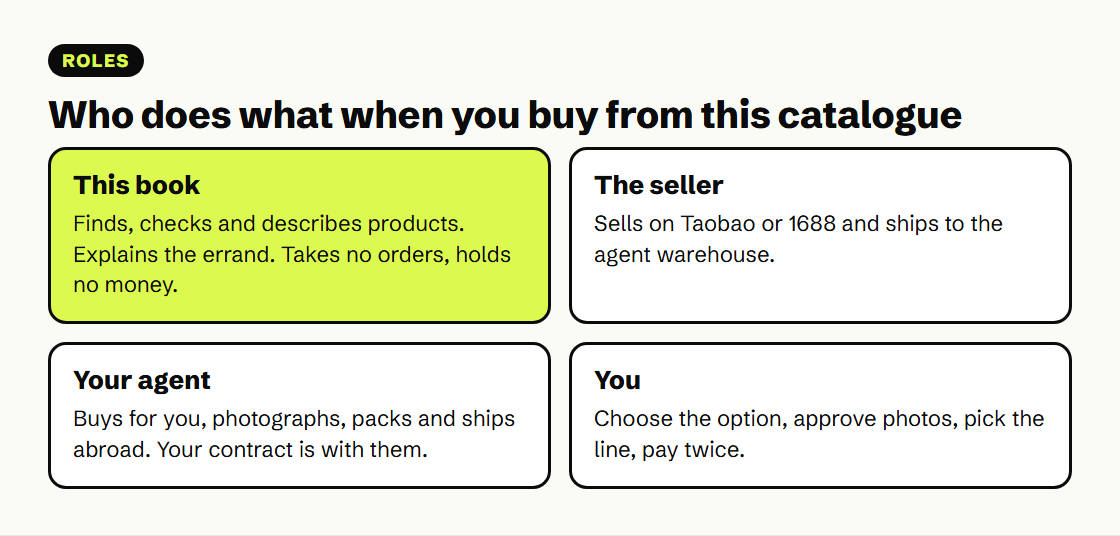
The Upopbuy Spreadsheet Errand Book is an independent product catalogue with buying notes. It is not the Upopbuy website, the company that published the Upopbuy app has no hand in it, and nobody at that company has reviewed or approved what we write. We use the name because people search for it, and because the company described itself as a Taobao agent, which is exactly the kind of shopping this book explains.
We do not sell anything, hold anyone's money or store parcels. Buying happens through whichever agent you choose; this book only helps you decide what to buy and how the errand works.
Why the cards beat a raw marketplace search
Taobao and 1688 between them list more products than anyone could read, and the search results are crowded with copies of the same photo at different prices. A catalogue earns its place only if it saves you the reading. Ours tries to do that in three ways.
- Sorted by how things are sized. The sixteen aisles are grouped by the measurement that decides whether a piece fits: chest, waist and foot, adjustable, or not worn at all. The size note on each card tells you what to measure on yourself before you open the menu.
- The menu read for you. Many listings hide their real price inside the option menu, where one colour or size costs more, or where the cheapest option is not the product in the photo. Each card says what we found there.
- Dated and linked straight to the listing. Every card shows the day we read it and the yuan price on that day, and links to the listing by its item number, so you can check us.
Alongside the shelves, the order errand follows a purchase from link to doorstep, and every page explains one stage in more depth.
{fig('cvz-fig-about-card.png', 'Three things each catalogue card adds over a plain marketplace search result: fit key, menu note and read date with item number', 'What a card adds on top of a search result. Drawn by this site.', scroll=True)}How each product reaches a shelf
We search Taobao and 1688 in Chinese through an agent-side product search, then read each candidate listing in both Chinese and English. A product only goes on a shelf if it passes all of these:
- No famous brand name or logo on the product, in the title, in the shop name or in the option menu.
- A price we can state: the lowest option price on the day we read it, in yuan, and on 1688 the smallest batch the seller sells.
- A menu we have read: we note options that cost more, options that are a different product, and size labels that need converting.
- A photo we have opened and looked at, so the card's description matches what is shown.
- Not already used by another catalogue we know of, so you are not shown the same handful of listings everywhere.
We did not buy these items. The cards describe listings, not products we have held, and say so. When we say "we read" or "we checked", that is what happened on the date shown, and nothing more. Prices were read on 24 October 2026.
We re-read every aisle at least once a month. Dead links, and listings that have changed into something else, are removed at each re-read and logged on the change notes page.
Money, links and corrections
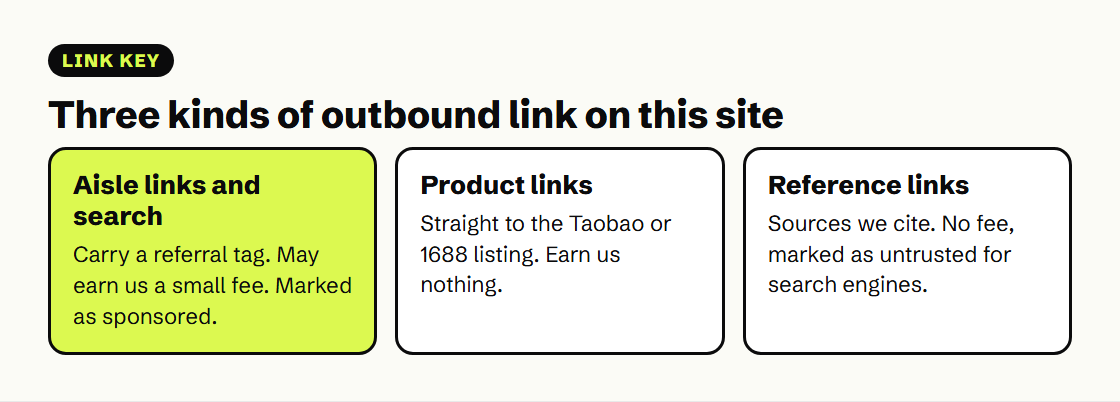
This site is paid in one way: both the shelf tiles and the search form include a referral label, which may earn us a small fee when readers browse or buy after following them. You pay nothing extra. Links straight to Taobao and 1688 listings earn us nothing, and no agent pays us to appear or to be left out. There is no advertising and we do not sell reader data.
Outbound links are marked for search engines as paid or untrusted where that applies. We do not use tracking cookies; the only tags are the plain referral labels on aisle links.
Corrections go to [email protected]. Tell us the page, what is wrong and, if you can, a link that shows the right version. We check before changing anything, and every correction is logged with its date. We would rather fix a mistake in public than leave it standing.